Which Tokyo Walks Are Worth It in Summer (And Which Aren’t)
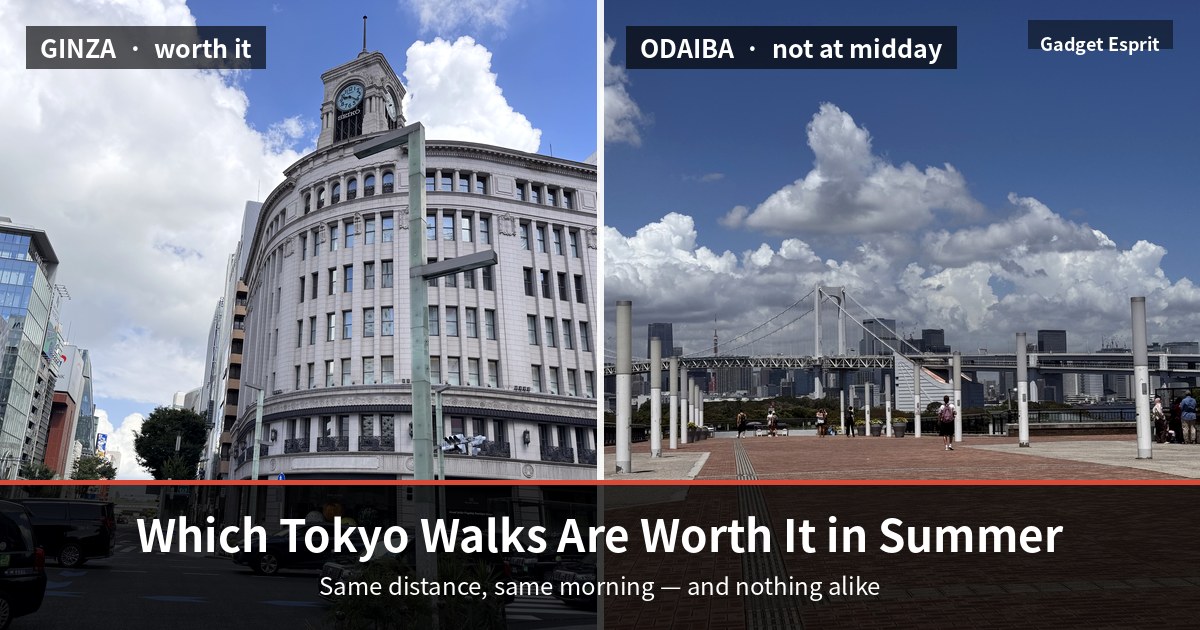
Tokyo looks walkable on a map. Large parts of it are. But on 7 August 2026 we did two walks in the same day, and only one of them was a good idea.
They were roughly the same length. The difference wasn’t distance.
The short version
- Tokyo Station → Ginza, on foot: worth doing. About 20 minutes to Ginza 4-chome. Buildings the whole way, shade from them, and something to look at.
- Odaiba, on foot: we’d think twice in August. The walkways are elevated decks with essentially no shade. We ended up route-planning around air conditioning.
If you only take one thing: in Tokyo, shade comes from buildings being close together. Where the buildings spread out, the walk gets much harder — and that has nothing to do with how far it looks on the map.
Walk 1: Tokyo Station to Ginza
We came out of Tokyo Station’s Yaesu Central Exit at 9:02 and started walking south.
Our actual clock:
- 09:02 out of the station
- 09:12 at the edge of Ginza
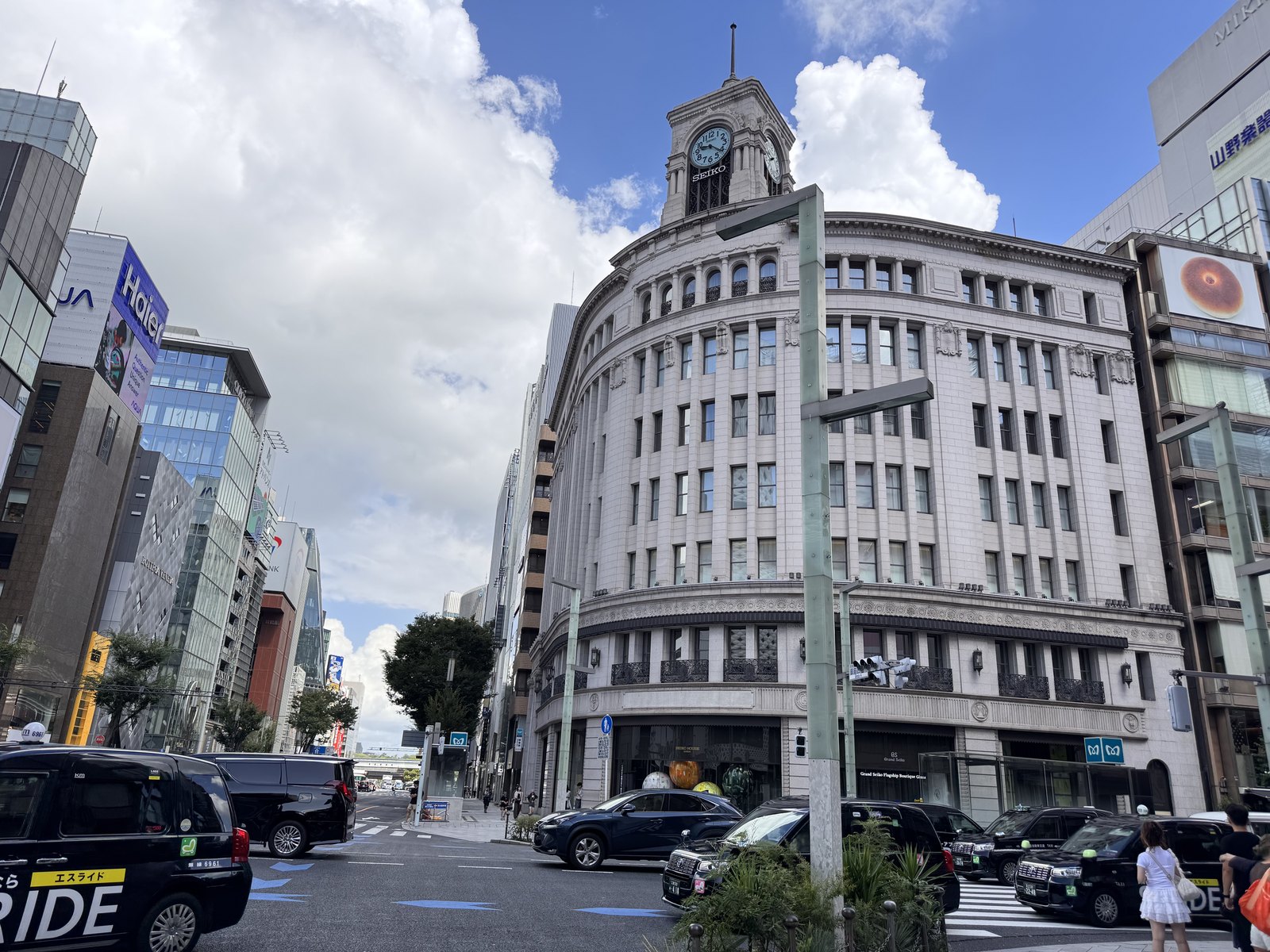
- 09:21 at the Wako clock tower, Ginza 4-chome
- 09:34 still in Ginza, heading for Shimbashi
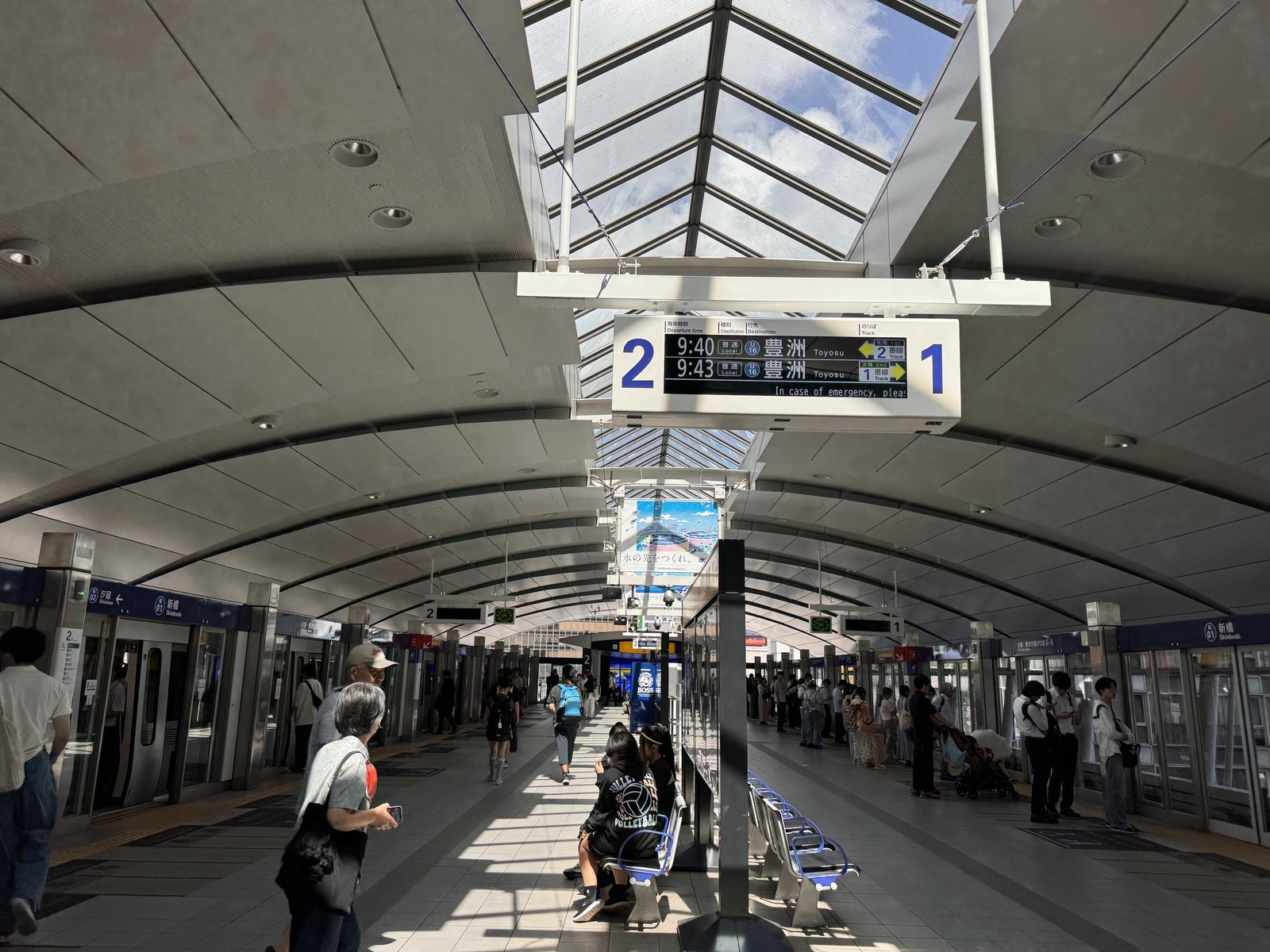
- 09:39 on the Yurikamome platform at Shimbashi
So: about 20 minutes from Tokyo Station to the middle of Ginza, without hurrying, in August. That’s the number I’d want to know before deciding whether to bother with the subway.
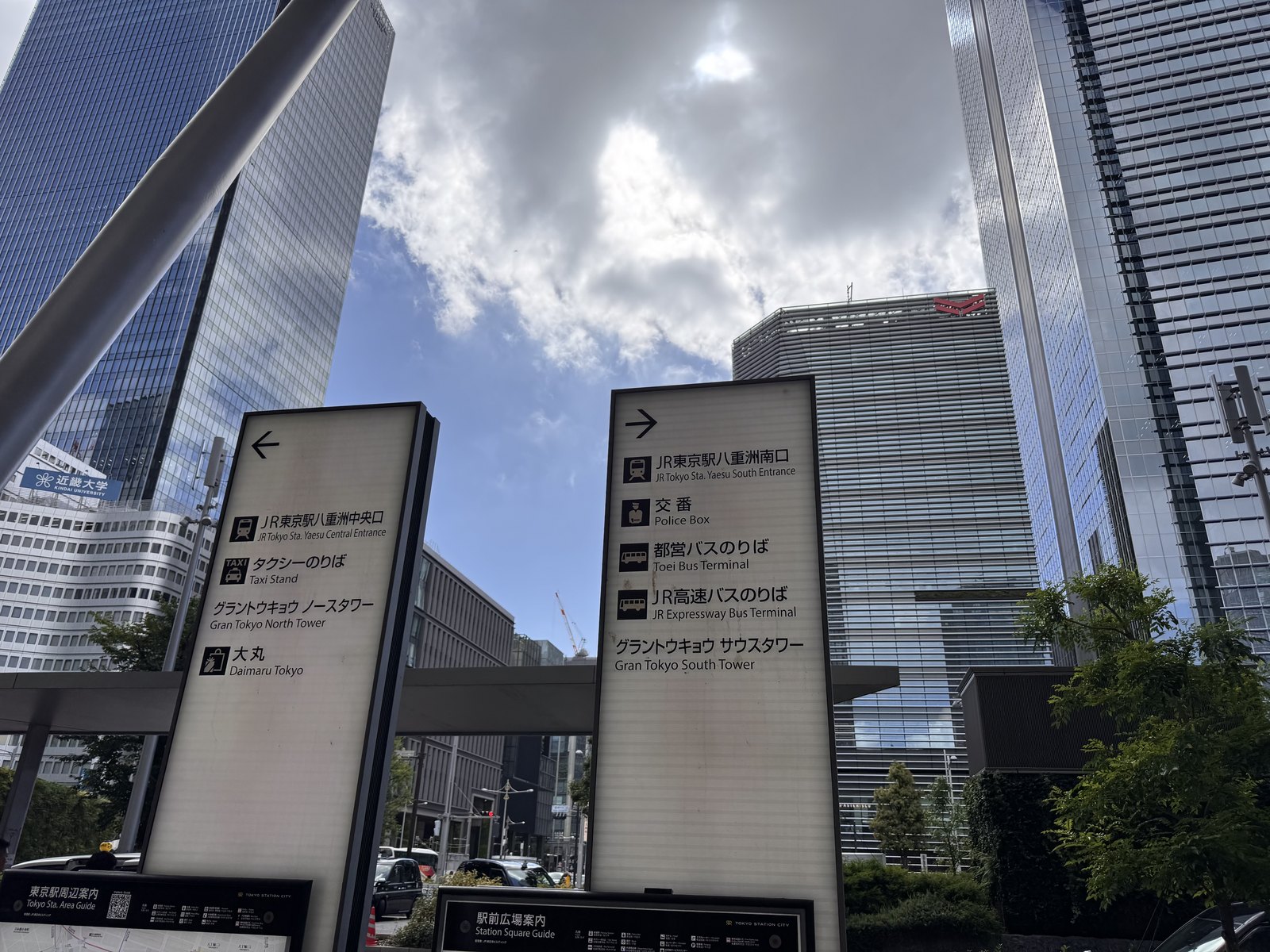
You will not get lost
This surprised me, and it’s the thing that makes the walk recommendable rather than just possible.
You follow the road that runs alongside the railway tracks, straight, and you turn once. That’s it. That single turn puts you at the Ginza 4-chome crossing.
For a first-time visitor in a city with a reputation for being hard to navigate, this is about as forgiving as a route gets. You don’t need to be counting blocks or checking your phone at every corner.
What made it worth it
Two things, and neither is what I expected.
The buildings around Tokyo Station. You get the scale of the place in a way you simply don’t from a platform or an underground passage. The Yaesu side is towers and elevated expressway and traffic, and walking out into it is a better introduction to central Tokyo than arriving into it.
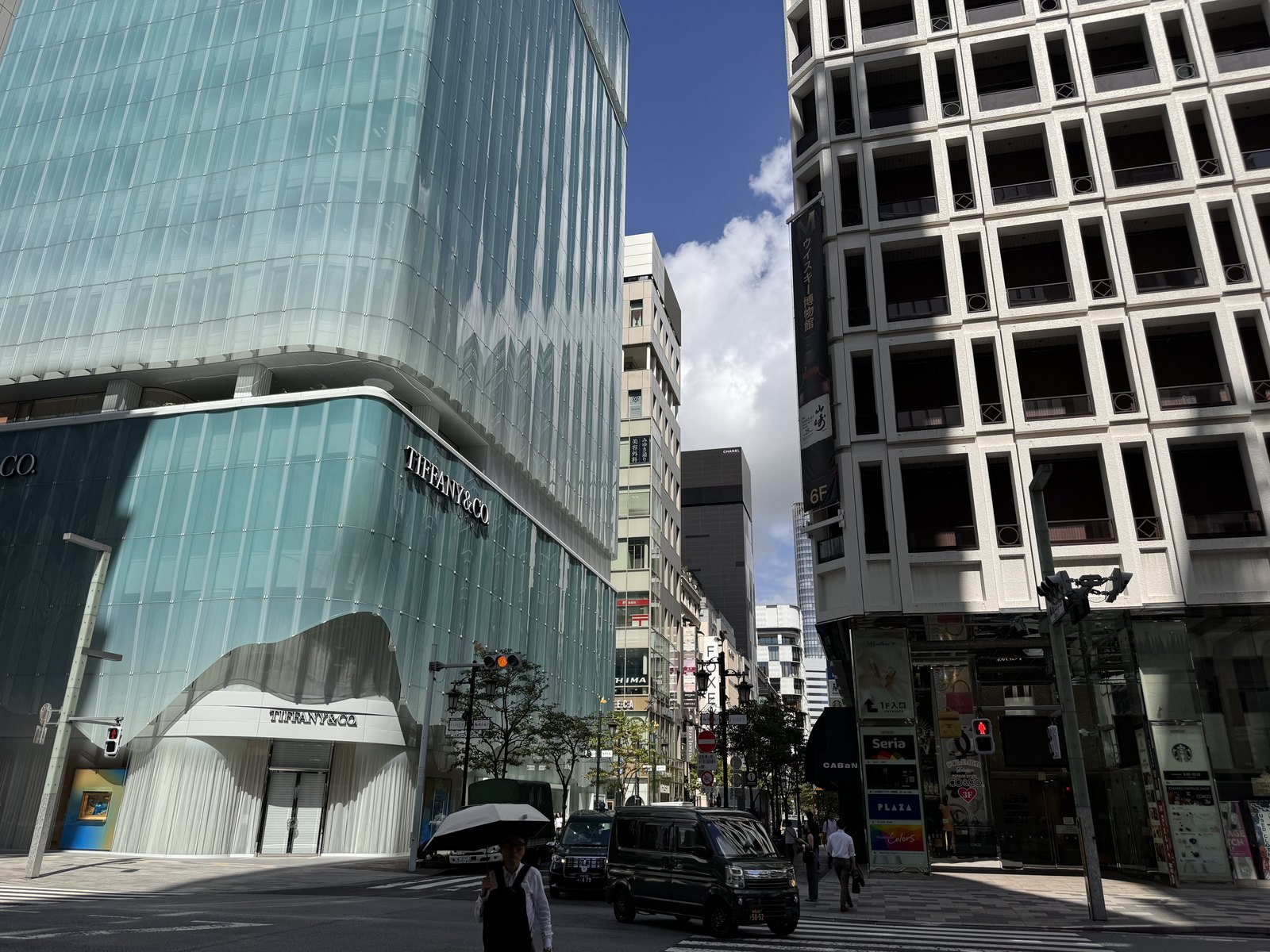
Then Ginza itself. The Wako clock tower at the 4-chome crossing, the Tiffany building, the whole run of flagship stores treated as architecture rather than shops. At walking pace you actually look up.
The honest catch: the shops aren’t open at 9
Here’s what I’d want to be told, and wasn’t.
Every shop we passed between 9:02 and 9:34 was still closed. The walk was quiet and easy — the pavements were clear, we weren’t weaving around anyone — and it was genuinely better for looking at the buildings than it would have been later.
But it also felt like something was missing. You’re walking through one of the most famous shopping districts in the world with nothing to go into.
I can’t tell you the opening time for any particular shop, and I’d check before building a morning around one. What I can say is that at 9 nothing was open to us, and 10 onwards is the safer assumption if shopping is the reason you’re going.
What was open: convenience stores and cafés. So you can get a coffee — you just can’t shop.
It’s the same trade we found at Senso-ji at 5:30 in the morning: an empty famous street is a different thing from the famous street, not a better version of it.
The part that makes this walk easy to justify: Ginza is on the way
This is the bit I’d underline.
We weren’t making a special trip to Ginza. We were going from Tokyo Station to the Yurikamome line at Shimbashi, to get out to Odaiba and Toyosu — and Ginza sits directly between the two. I’d wanted to walk through it once, and the route went through it anyway.
So the walk cost us almost nothing. If your day involves getting from Tokyo Station to the Yurikamome, you can have Ginza for the price of walking instead of riding. That’s a much easier decision than “should we go to Ginza.”
Ginza to Shimbashi itself is ordinary office district. After Ginza the drop-off is obvious — much less to look at. And to be clear about the timings below: that stretch was straight walking, not strolling. We weren’t dawdling.
Walk 2: Odaiba, in the middle of the day
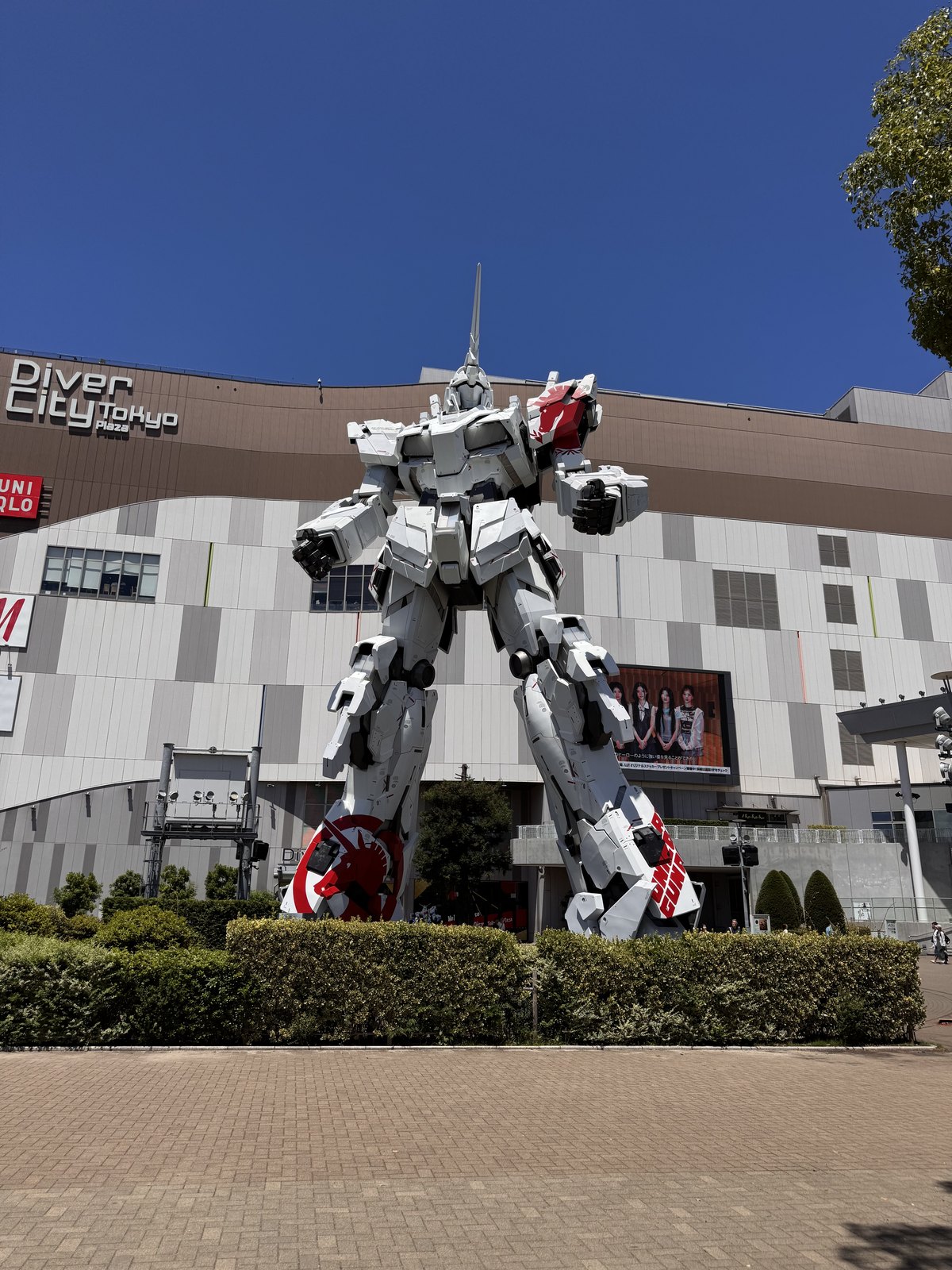
A note on what we actually did, because it’s easy to get this wrong: we did not walk out to Odaiba. We took the Yurikamome from Shimbashi — Daiba is the sixth stop — and the walking was within Odaiba: roughly the stretch past Aqua City and Fuji TV to DiverCity, between about 11:08 and 11:42.
That’s not a long way. It was still the hardest half hour of the trip.
The problem is that there is no shade
Odaiba is built on reclaimed land, and you move around it on wide elevated decks and walkways. It’s well designed and it’s pleasant to look at. It is also, in the middle of an August day, almost completely without shade.
That’s the whole story. Not distance, not hills, not crowds. There is simply nowhere for the sun not to be.
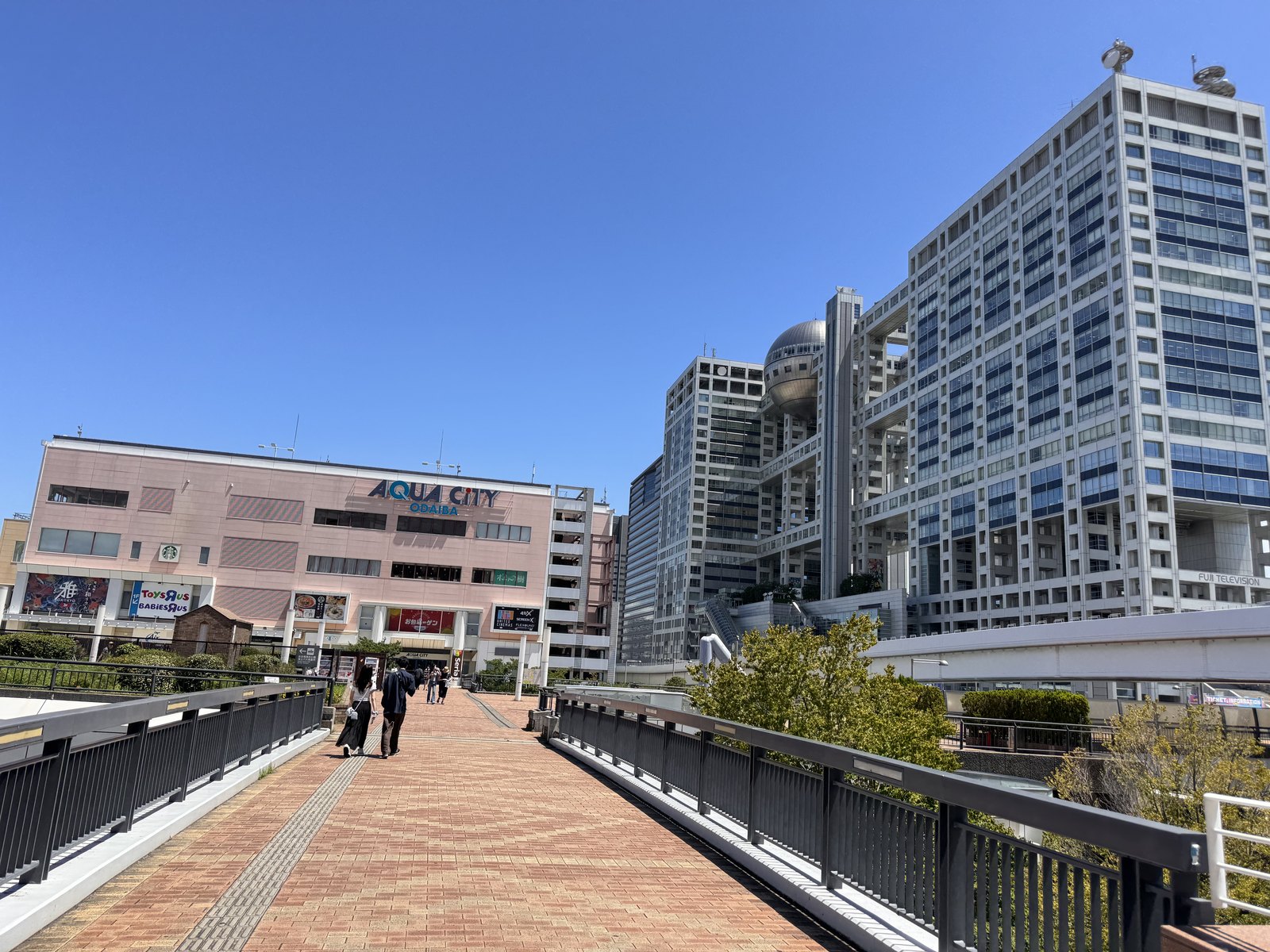
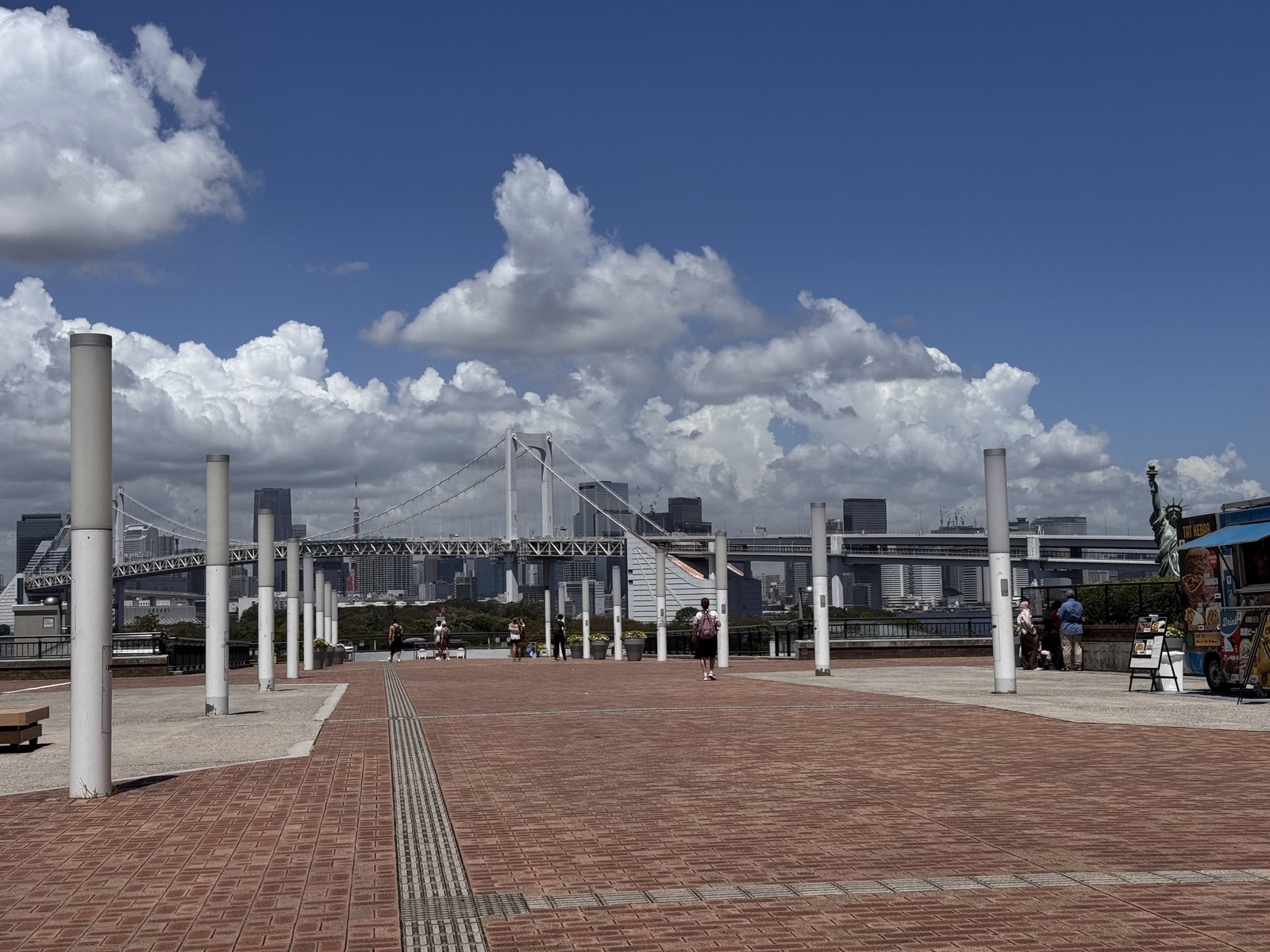
Compare that with the Ginza walk earlier the same morning. Ginza has buildings pressed up against the pavement, so there’s a shadow to walk in for most of it. Odaiba has space — and space, in summer, is the problem.
What we actually did about it
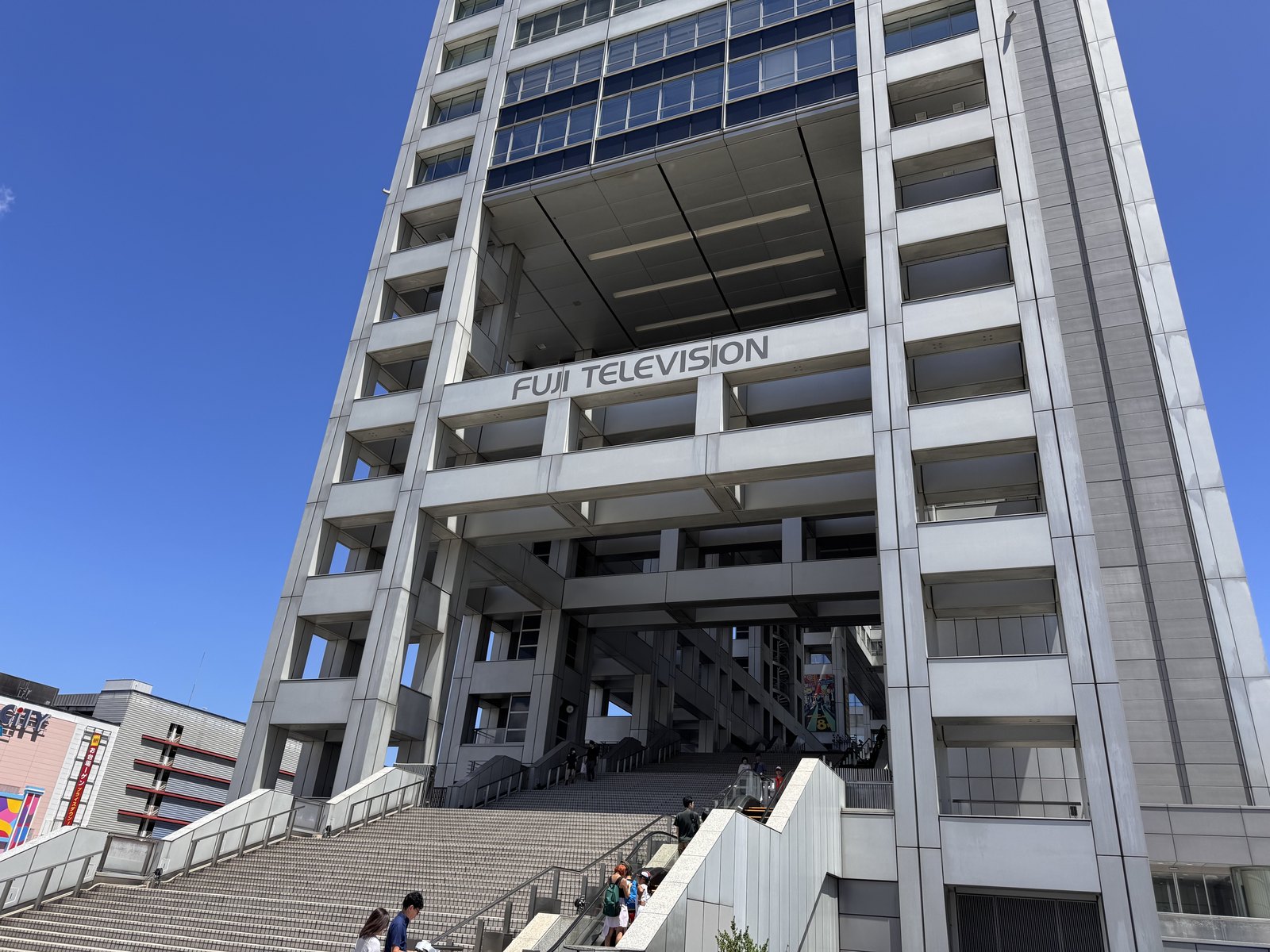
We planned the route around buildings we could get inside. Aqua City, DiverCity Tokyo Plaza, and the Fuji TV building — we went into all three, and not entirely for what was in them. Air conditioning was a large part of the appeal.
On drinks, one specific thing worth knowing. There are vending machines out on the decks. But standing in full sun to buy and drink something didn’t help much — the problem wasn’t only thirst, it was being outside. There’s a LAWSON convenience store inside the Fuji TV building, and going in there for a drink was far better than the machine outside: you get the drink and you get twenty minutes out of the sun.
Then we sat down on a bench in Aqua City for a while. That was the actual fix. Not the drink — the sitting, indoors.
If you’re planning an Odaiba walk in summer, I’d build it around those two: somewhere indoors to buy a drink, and somewhere indoors to sit. The outdoor infrastructure is good-looking and it does not help you.
One more thing about this particular corner
You are standing outside a national broadcaster, and they film on the street.
Coming out of that convenience store, a crew stopped us and asked whether they could film us for an evening news segment. As far as we can tell it never aired.
It happened to us once, so I can’t tell you how common it is. But you are standing outside a broadcaster’s front door, and this is clearly something they do on that street.
Worth knowing if you’d rather not be filmed: it was a polite ask, and you can say no.
The hat
The thing I’d change, and the reason I’m writing this section at all.
My family were wearing hats. I wasn’t.
I spent a good part of that walk thinking about where I could buy one — not idly, but as an actual plan. The sun was strong enough that a hat stopped being an accessory and became equipment.
If you’re coming to Tokyo in July or August: bring a hat, or a parasol, and bring it on the day you’re doing Odaiba. Plenty of people here carry a parasol in summer, including men, and nobody will look at you twice. I didn’t have either, and I noticed for about half an hour straight.
So what separates the two walks?
Not distance — they’re comparable. What differs:
| Tokyo Station → Ginza | Around Odaiba | |
|---|---|---|
| Shade | Buildings close to the pavement, most of the way | Open decks, essentially none |
| What you’re looking at | Architecture, street life, scale | Views, water, big open space |
| If it gets too hot | Shops and cafés on both sides | A handful of large complexes, spaced out |
| Our verdict in August | Do it, early | Do it, but not on foot in the middle of the day |
The rule of thumb we came away with — from two walks, so treat it as a starting point rather than a law: before deciding to walk somewhere in summer, look at whether the buildings come right up to the pavement. Where they do, there’s a shadow to walk in and somewhere to duck into. Where the space opens out, the same distance costs you a great deal more.
Distance on the map didn’t predict which of our two walks was harder. That did.
The facts
What we observed on 7 August 2026 (a Friday)
- Tokyo Station Yaesu Central Exit to Ginza 4-chome: about 20 minutes on foot, ordinary pace
- Ginza 4-chome to Shimbashi: about 18 minutes, straight walking, not strolling
- Whole route, Tokyo Station to the Yurikamome at Shimbashi: about 37 minutes, with one turn
- Ginza’s shops were closed at 9 AM; convenience stores and cafés were open
- Odaiba walking, roughly 11:08–11:42: elevated decks with essentially no shade
- Vending machines on the open decks; a LAWSON inside the Fuji TV building
- Benches inside Aqua City — where we actually rested
Not verified
- Opening hours for individual shops in Ginza. We only know they weren’t open at 9 and that 10 onwards is the safer assumption.
- Whether the Odaiba decks are equally exposed outside summer. We were only there in August.
- Whether shaded seating exists outdoors in Odaiba. We didn’t find any on our route, but we weren’t searching systematically.
Would we do them again?
Tokyo Station to Ginza: yes — and I’d recommend it to anyone staying near Tokyo Station who has 20 minutes and hasn’t seen Ginza. Just go outside the summer months, or go early and accept that the shops are shut.
Odaiba: yes, but differently. It’s worth seeing. We’d go in the morning or the late afternoon rather than the middle of the day, and we’d treat the indoor complexes as part of the route rather than as a fallback.
And bring the hat. I still think about the hat.
Where this fits in the trip
Both of these walks happened on the first day of a two-day family trip to Tokyo in August 2026.
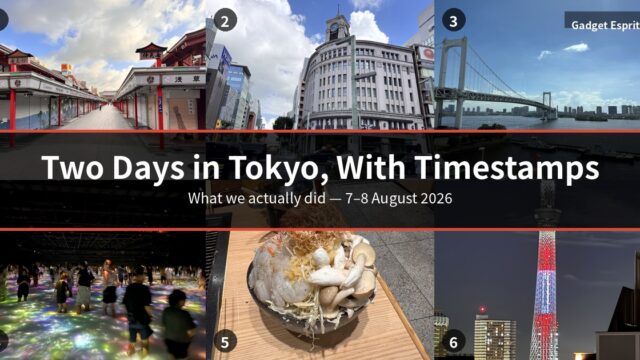
→ Two Days in Tokyo, With Timestamps: What We Actually Did — the full two-day record, every time taken from a photo.
→ teamLab Planets with Kids — where we went after the Odaiba walk.
→ Monjayaki in Tsukishima — dinner that evening, and whether you have to cook it yourself.
→ Asakusa at 5 AM — the next morning, before the shops opened.
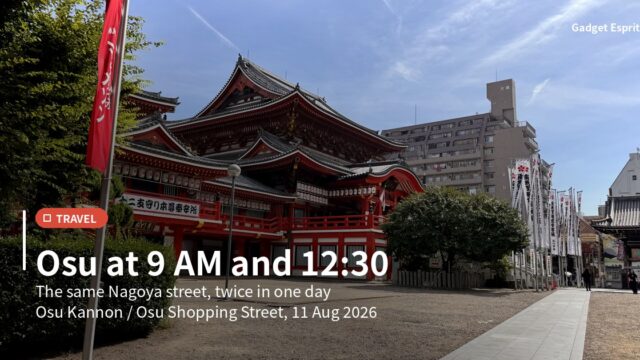
→ Osu at 9 AM and at 12:30 — the same shade problem in Nagoya, solved by covered arcades. We walked between two districts rather than sitting in the sun.