Tokyo 2-Day Itinerary with Kids: Asakusa, teamLab & Tsukishima
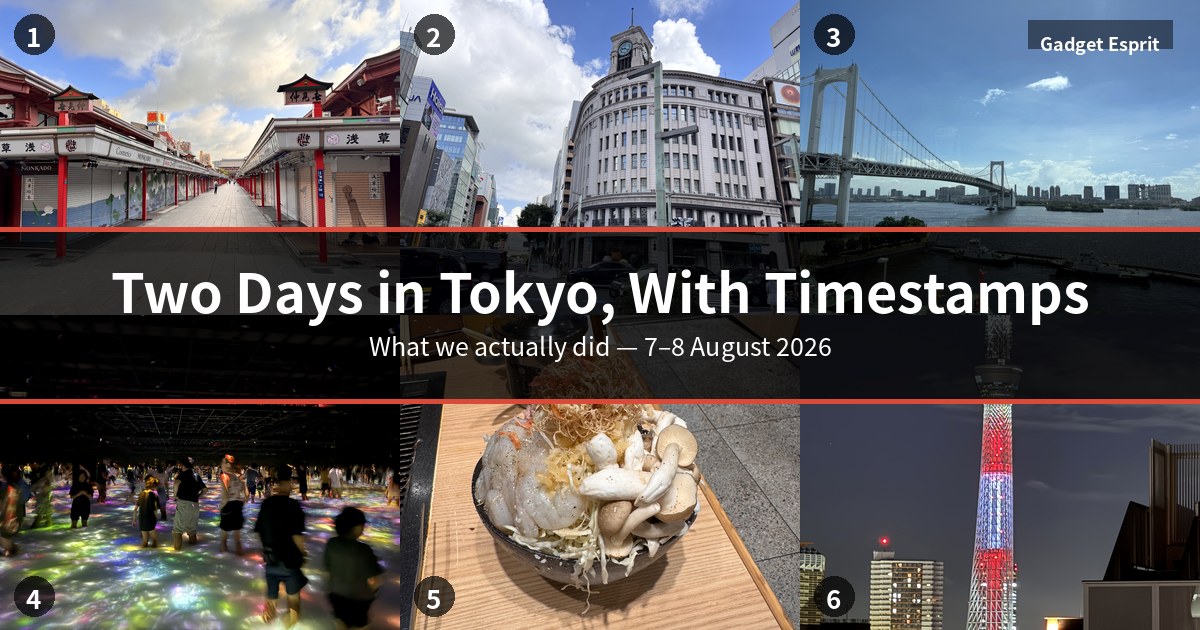
This is a record of our two-day family trip to Tokyo: Tokyo Bay, teamLab Planets and a monjayaki dinner in Tsukishima on day one, then an early-morning walk in Asakusa and time at Tokyo Station on day two.
We’re a family of four — two adults, two school-age children — and we did this on 7–8 August 2026, which in Tokyo means heat. Every time below comes from the timestamp on a photo we took, so it’s what actually happened rather than what a plan said should happen.
A note on the gaps. This is a record of where our camera was, not a minute-by-minute log. There are stretches with no entry — meals, moving between places, sitting down because it was 35 degrees. We haven’t invented anything to fill them.
We got some of it right. We got a few things wrong, and those are more useful.
Our route at a glance
- Day 1 (Fri 7 Aug) — the bay and dinner: Tokyo Station → Ginza and Shimbashi on foot → Yurikamome to Odaiba, where the family looked around while I went on to a trade show at Tokyo Big Sight → back together in Odaiba → teamLab Planets in Toyosu → an air-conditioned break at LaLaport Toyosu → monjayaki in Tsukishima → subway to our hotel in Tawaramachi.
- Day 2 (Sat 8 Aug) — Asakusa and Tokyo Station: an early walk around Senso-ji and the Sumida River → breakfast and a rest at the hotel → Asakusa again → rest and checkout → subway to Tokyo Station for lunch and shopping → Shinkansen home.
Our conditions: school-age children, a lot of walking, and two backpacks rather than suitcases. We took indoor breaks on both days because of the heat, and we had booked teamLab Planets and the Tsukishima dinner in advance.
The five things we’d tell someone doing this
- Book the fixed-time ticket first. teamLab Planets was the only thing on our trip with a hard time slot, and a week out the afternoon was already sold out. Everything else bent around it.
- Walk where the buildings are close together; take the train where they aren’t. Tokyo Station to Ginza on foot was one of the best parts of the trip. The same distance around Odaiba, on open decks with no shade, was the worst.
- Early morning isn’t cool in August — it’s just less hot. Worth doing anyway. Just don’t expect relief.
- Carry ¥100 coins. The omikuji at Senso-ji was cash into an unattended box, and we found nowhere nearby to break a note.
- Give the last afternoon more time than you think. Tokyo Station during the summer holiday period cost us far more time than any sightseeing did.
Day 1 — Friday 7 August
09:00 · Arrive at Tokyo Station
Off the Shinkansen just before 9, out through the Yaesu Central Exit, and walking by 09:02. No stop, no drop-off. We had backpacks only, which made this possible.
09:02–09:39 · Tokyo Station → Ginza → Shimbashi, on foot
The whole way on foot, about 37 minutes at an ordinary pace.
Why this worked: Ginza sits between Tokyo Station and the Yurikamome line at Shimbashi. We weren’t making a trip to Ginza — it was on the route to the train we needed. You follow the road along the railway tracks, turn once, and you’re at the Ginza 4-chome crossing.
The catch: at 9 AM the shops are shut. Convenience stores and cafés are open; shopping is not. Good for architecture, frustrating if you came to buy something.
→ Full detail: Which Tokyo Walks Are Worth It in Summer
09:39 · Yurikamome across the bay
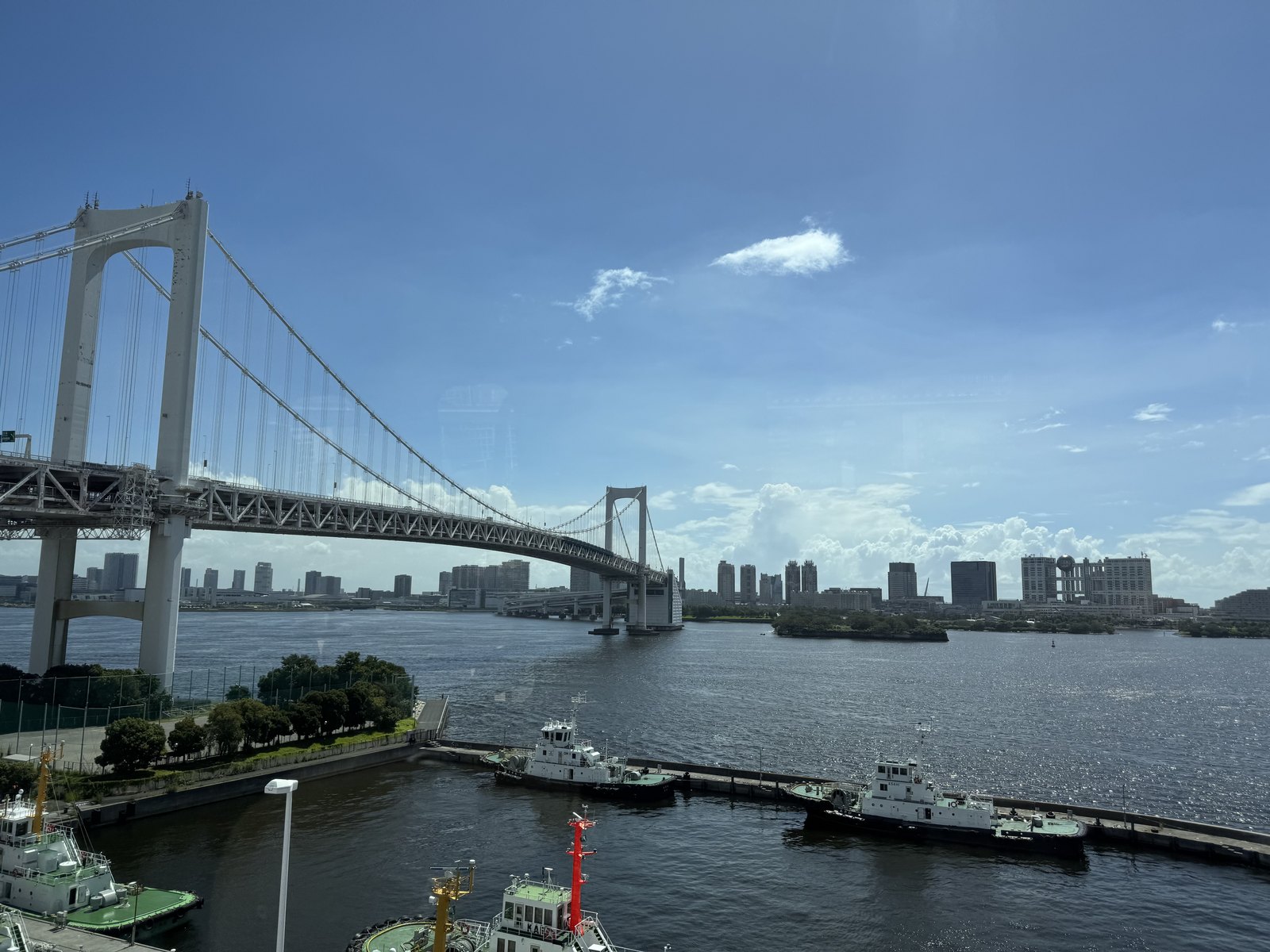
The Yurikamome is a driverless line on an elevated track, and the ride is a sight in its own right. It curves out over the water past Rainbow Bridge, with the container terminals and the whole waterfront below you.
Sit at the front if you can. There’s no driver’s cab, so the front window is just a window.
09:55–11:00 · We split up
Worth putting in, because family trips actually work like this and itineraries never admit it.
The family got off at Daiba — the sixth stop from Shimbashi — and had a look around. I stayed on to the end of the line, to Tokyo Big Sight, and we met up again just after 11:00.
I was there for a trade show in my own industry. I work in sewerage and water infrastructure, and the annual exhibition happened to fall on the day we arrived, so I went for an hour while everyone else did Odaiba without me.
That’s not a recommendation for your Tokyo trip. But Tokyo Big Sight is worth knowing about as a place, because a lot of people’s reason for coming to Tokyo is an event held there — Comiket, motor shows, trade fairs, anime events. It’s the enormous inverted-pyramid building out at the end of the Yurikamome, and if that’s why you’re in Tokyo, everything in this article about the Yurikamome and Odaiba is your neighbourhood for the day.
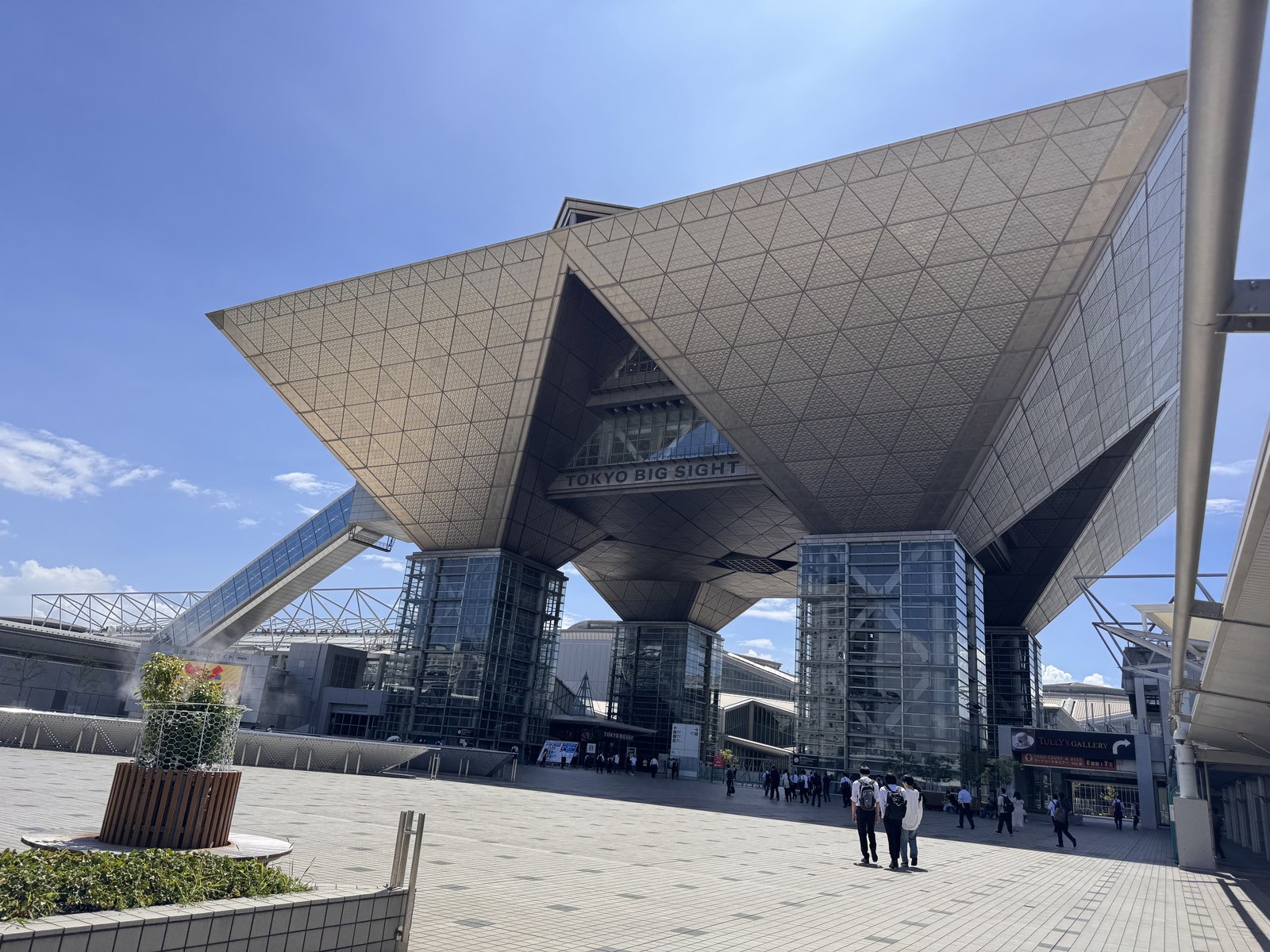
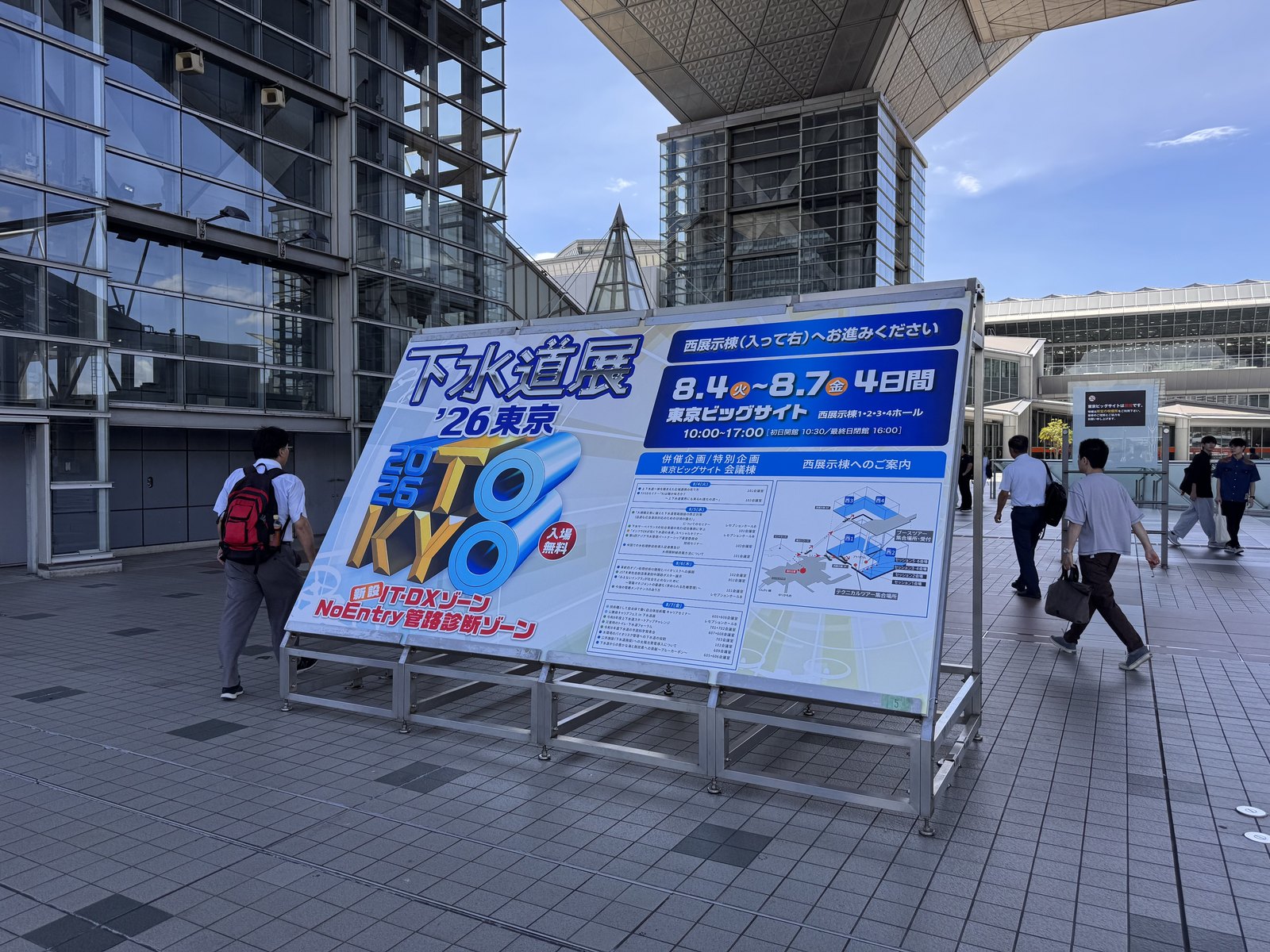
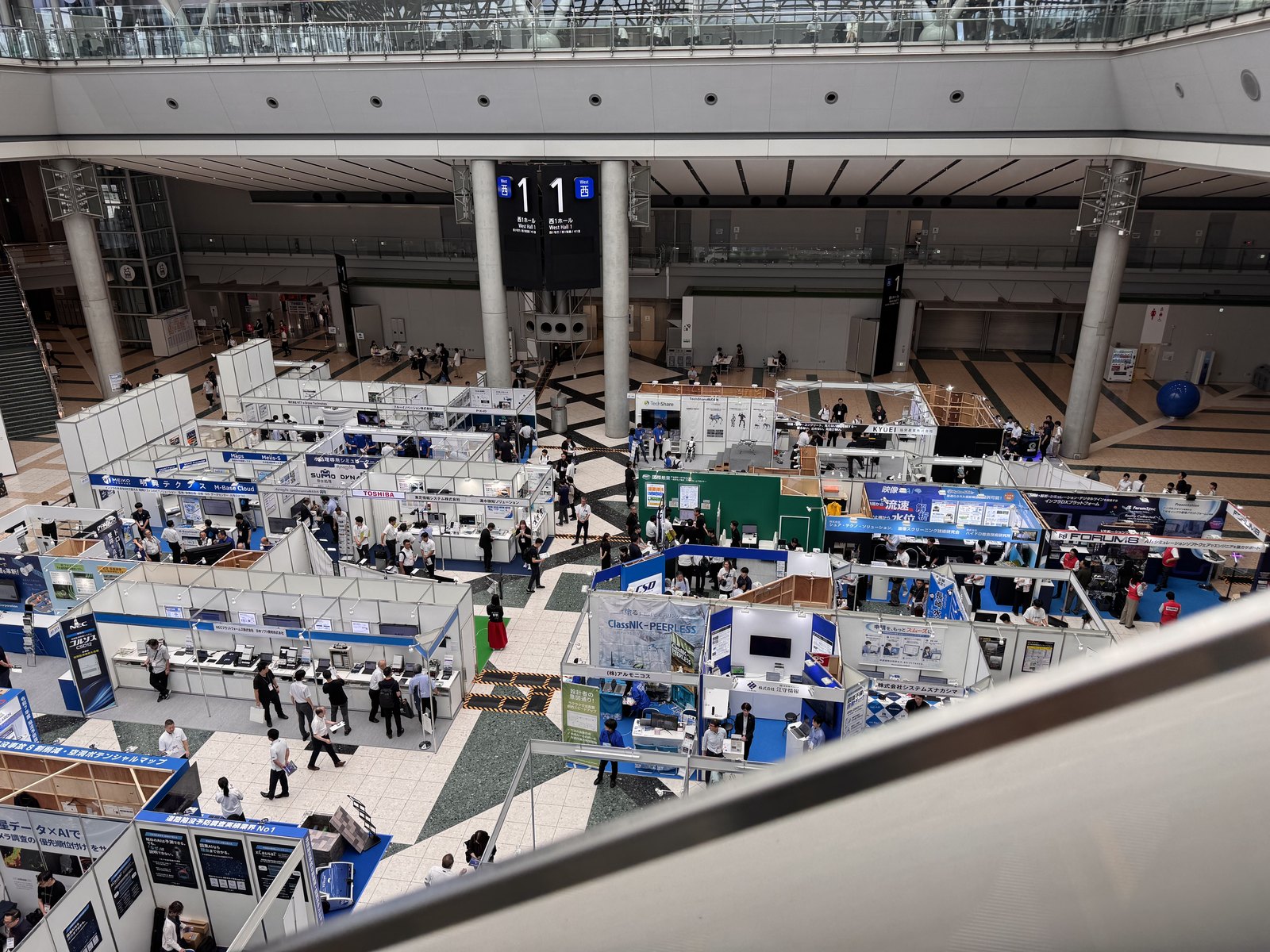
The practical point for families: splitting up for an hour cost us nothing and got everyone something they wanted. The Yurikamome is a single line with no branches, so regrouping is easy — you agree a station and a time.
11:08–11:42 · Around Odaiba, on foot
This was our mistake. Not the distance — barely half an hour — but the conditions. Odaiba’s walkways are wide elevated decks with essentially no shade, and this was the middle of an August day.
We ended up routing between air-conditioned buildings and lost the momentum of the morning.
→ Why the same distance felt so different here and in Ginza: Which Tokyo Walks Are Worth It in Summer
12:06 · Lunch at DiverCity
Food court, no reservation, no language barrier. The chuka soba at Tanaka Soba Ten was the best thing any of us ate on the trip.
This turned out to be a scheduling decision, not just a meal. teamLab’s on-site restaurant is behind the ticket gate and you can’t go in before your admission time — so lunch had to happen before, or not at all.
13:03–15:51 · teamLab Planets, Toyosu
Yurikamome from Daiba to Shin-Toyosu, no transfer, about 15 minutes. Out of Exit 1A and the building is right there.
Queued at 13:03, through the gate about 13:15, back outside at 15:51. Roughly three hours door to door — more than we’d planned for, because our children went round the Water area three times.
→ Full detail: teamLab Planets with Kids
15:51–17:21 · Toyosu, waiting it out
Not glamorous, and worth including precisely because itineraries never do.
We had a dinner reservation in Tsukishima and time to fill, so we bought drinks at LaLaport Toyosu and sat until it was time to go. After three hours on our feet and a day in the heat, a shopping centre with air conditioning was exactly the right thing.
If you’re travelling with children in summer, build one of these into the day on purpose.
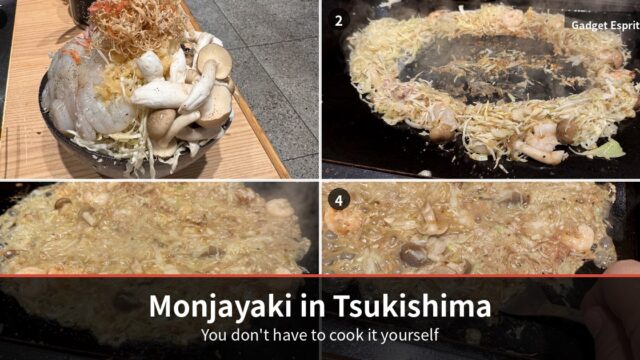
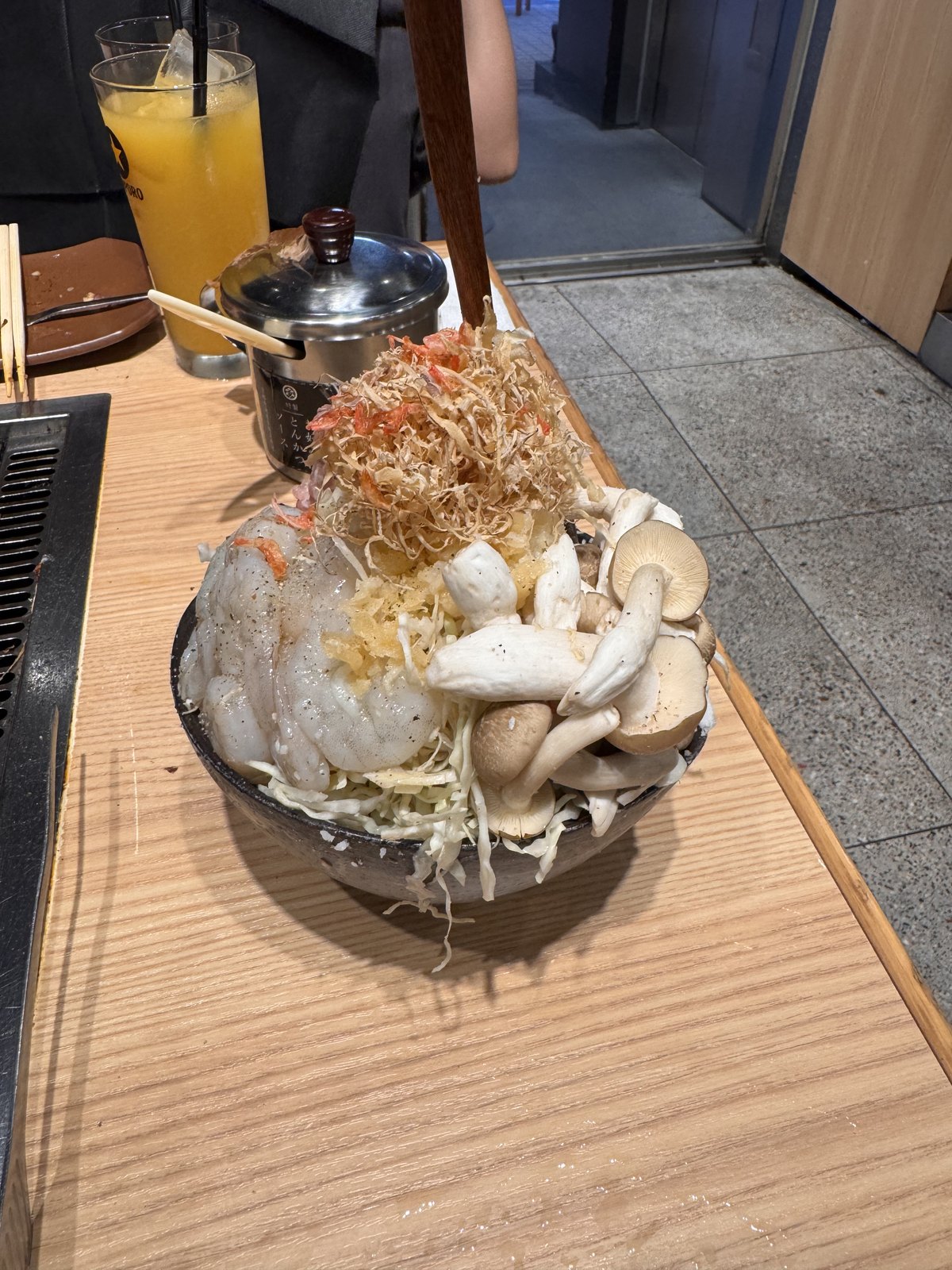
17:21–19:35 · Monjayaki in Tsukishima
Dinner at Tsukishima Monja Koboreya Sohonten. We’d reserved for 17:30 and arrived a little early; they seated us straight away and we started at about 17:20.
Three things that surprised us, and made it easier than it looked:
- They asked whether we wanted to cook it or have them do it — for the okonomiyaki and monja, at least. We had them do all of ours. The teppanyaki dishes we cooked ourselves.
- You order from your own phone. The ordering screen had an English option, though we ordered in Japanese.
- Two hours went by without anyone hurrying us.
→ Full detail: Tsukishima Monja Koboreya Sohonten Review: Dinner with Kids
19:35–20:11 · Subway to Asakusa
Straightforward. We were at the hotel in Tawaramachi by around 20:11.
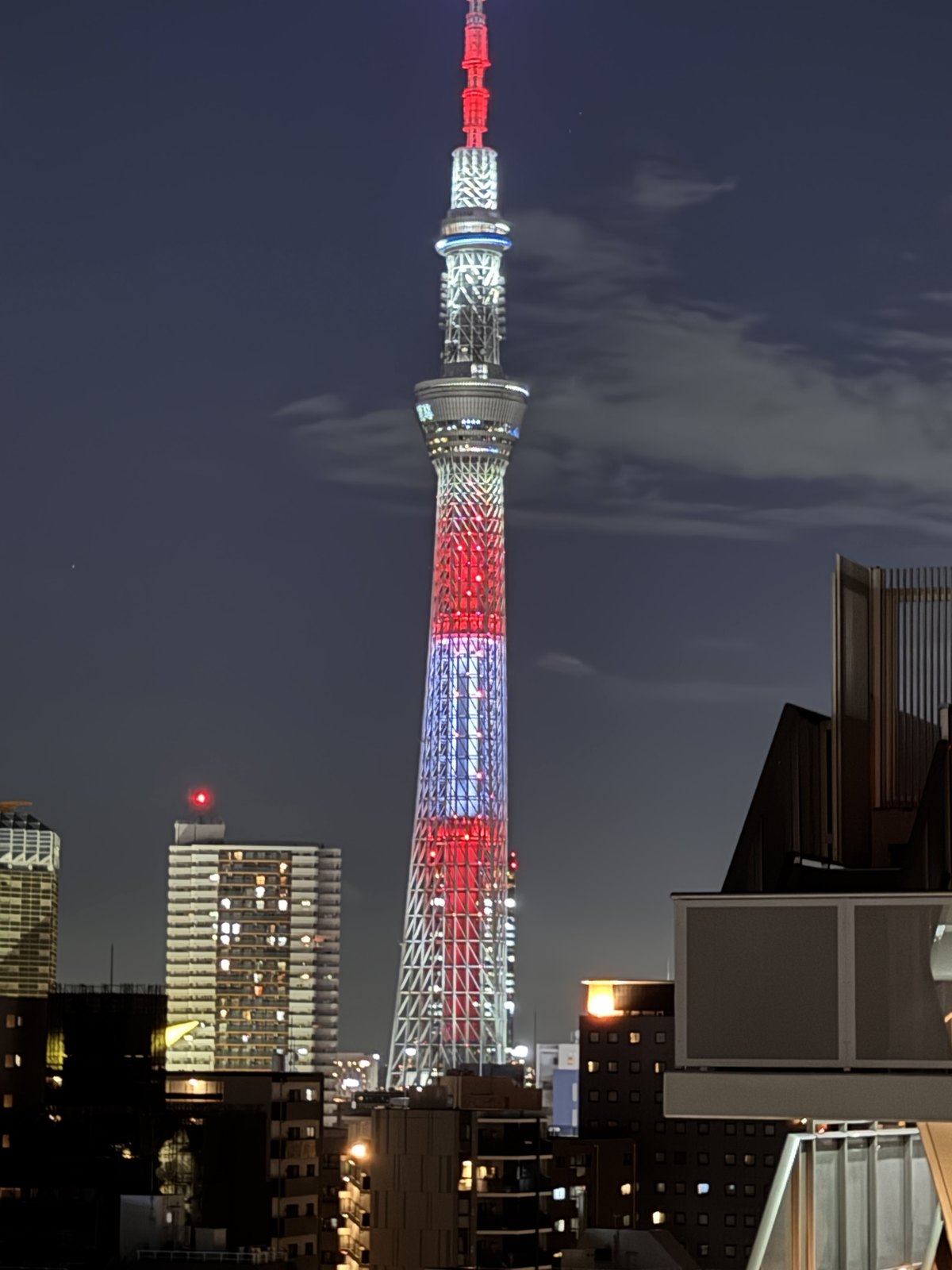
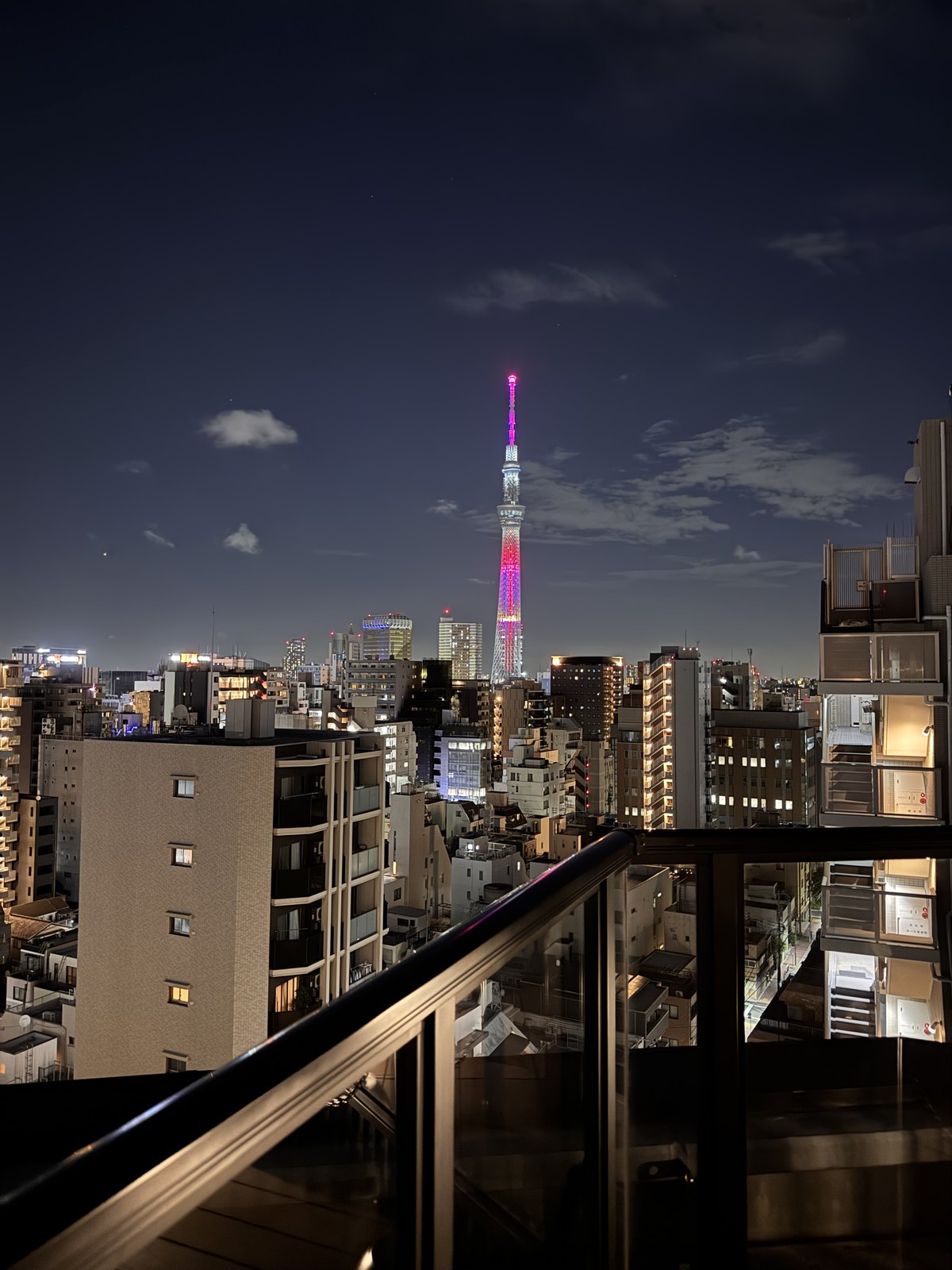
20:44 · Tokyo Skytree from the hotel roof
We didn’t go anywhere for this.
Our hotel has a roof terrace that any guest can go up to, and Skytree is lit up and clearly visible from it. No ticket, no queue, no second trip out into the heat — we went up before bed and that was the view.
If you’re choosing a hotel in Asakusa, it’s worth checking whether it has roof access. It’s the sort of thing that doesn’t appear in the headline description and turns out to be one of the better parts of the stay. Ours listed it on the floor guide in the lift lobby, in English as well as Japanese — “Roof Deck”, top floor.
Day 2 — Saturday 8 August
05:25 · Out of the hotel
The alarm went off and we walked out into Tawaramachi at 5:25. We’d bought onigiri at the convenience store the night before, so nothing held us up.
This is the day’s best decision, and it only worked because we were staying ten minutes from Kaminarimon.
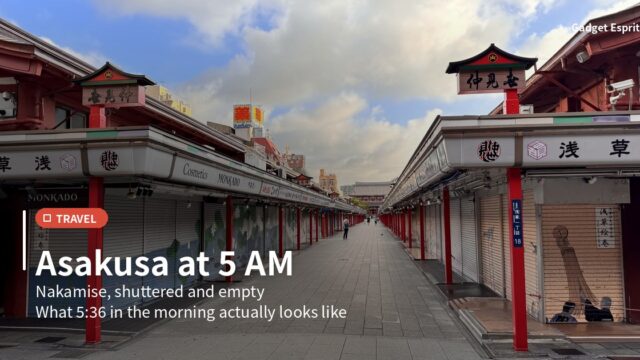
05:34–06:00 · Senso-ji, empty
Kaminarimon with nobody in front of it. Nakamise shuttered end to end.
The Main Hall was closed the whole time we were there. Officially it opens at 6:00, and we left the precinct at about 6:00 — so this part of the morning is the streets, not the temple interior.
Our biggest regret of the trip: we didn’t know about the 6:00 opening. We were down at the river by 6:07. Twenty more minutes standing still and we’d have seen the doors open with the precinct almost empty — and instead we walked away from it without knowing.
→ Full detail: Asakusa at 5 AM
06:07–06:30 · Sumida River and Skytree
Along the river past the Asahi building and over toward Skytree. Solamachi wasn’t open yet — treat it as the turnaround point, not a destination.
We jogged part of the way back. At 5:30 we’d been noting how many locals were out running; by half six we were two of them.
06:30–08:13 · Back to the room
Showers and breakfast at the hotel. Having walked and jogged for an hour before breakfast, this was not optional.
08:13–09:01 · Senso-ji again, then two more temples
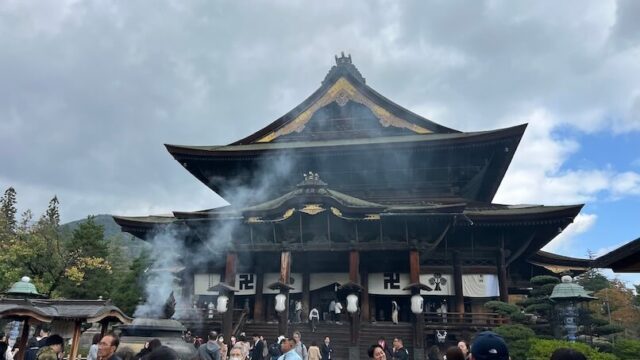
Back at the temple at 08:13 — noticeably busier, still easy to walk, shops still shut. The Main Hall was open this time, and we went in.
Omikuji at 08:21: self-service, ¥100 in cash into an unattended box, English explanation provided. Both our children drew kyō — bad fortune.
Through Asakusa Shrine at 08:34, where wind chimes were hung through the grounds for the summer.
Then fifteen minutes further out to Matsuchiyama Shoden, the “radish temple”, where the offered daikon were being left out to take home. I walked back through Asakusa carrying one.
09:45–11:00 · Back to the room until checkout
We were done with Asakusa by about 9:45, went back to the hotel, and stayed in the room until the 11:00 checkout.
This sounds like dead time and it wasn’t. We’d been walking since 5:25. An hour of air conditioning before heading out into the middle of the day was the difference between finishing the trip well and finishing it exhausted.
If you do an early start, plan the recovery into the same day.
11:00–11:56 · Subway to Tokyo Station
From Tawaramachi, changing at Ginza. Straightforward with backpacks; it would have been less pleasant with suitcases.
11:56–13:02 · Tokyo Station, lunch
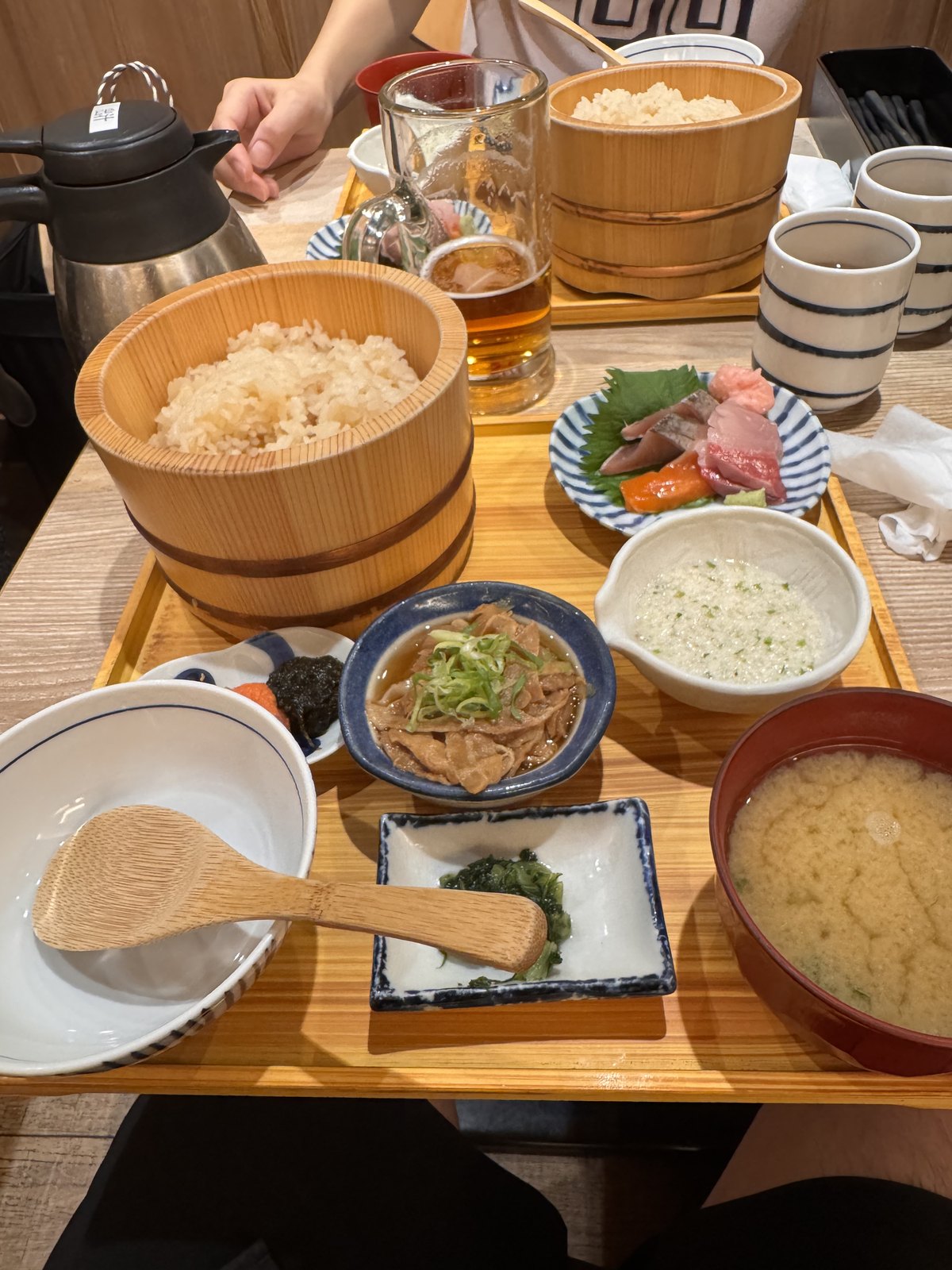
Back to Tokyo Station and lunch at Tokyo Kotobuki, in the station’s restaurant area.
This was the best meal decision of the trip. The sea bream rice — tai-meshi — comes with free refills on every set, and with two hungry children after a morning of walking, that mattered more than it sounds. Everyone ate as much as they wanted and we all left happy.
Ordering was done from our own phones, as it had been in Tsukishima.
13:02–15:42 · Tokyo Station, and the part we got wrong
Two and a half hours at the station before our train, and we used almost all of it.
We went to Tokyo Character Street for the children, and looked for souvenirs. What we hadn’t accounted for was the queues at the tills. It was the summer holiday period, the station was full, and paying for things took a very long time.
There was a second problem. Our backpacks had got heavy, and we went looking for a coin locker. We found four separate locker areas, on the ground floor and the basement level. Every locker in all four was occupied.
There is no shortage of coin lockers at Tokyo Station. On that particular Saturday there was a shortage of empty ones.
So: if your trip ends at Tokyo Station during a Japanese holiday period, give yourself more time than seems reasonable — not for the shopping, but for the paying and the not-finding-a-locker. Two hours was not comfortable.
15:42 · Shinkansen home
What we’d change
Stay 20 minutes longer at Senso-ji. This is the one we actually mind. The 6:00 opening, with an empty precinct, was there for the taking.
Bring a hat. My family had them. I didn’t, and spent half an hour in Odaiba thinking about where to buy one.
Don’t walk Odaiba at midday. Morning or late afternoon. The place is worth seeing; the middle of the day isn’t the time to see it on foot.
Treat the last afternoon as a scheduled item. We treated Tokyo Station as buffer. It wasn’t.
Nothing about the plan itself. The shape of the two days — one day out on the bay, one day in the old city, with a fixed-time ticket anchoring the first — worked. We’d do that again.
The practical summary
What we booked in advance
- teamLab Planets — a week ahead, and the afternoon slots had already gone
- Monjayaki in Tsukishima — reserved
- Nothing else
What we carried
Backpacks only, two of them. This is what made the walking possible and the transitions quick. A suitcase would have changed this trip significantly — and would have run into the locker problem at the end.
What cost us the most
Not money, and not distance. Heat and shade. The single biggest difference between an enjoyable stretch and a miserable one was whether there were buildings close enough to throw a shadow.
→ Osu at 9 AM and at 12:30 — we did the same timestamped thing in Nagoya, on one district instead of two days.