Tsukishima Monja Koboreya Sohonten Review: Dinner with Kids
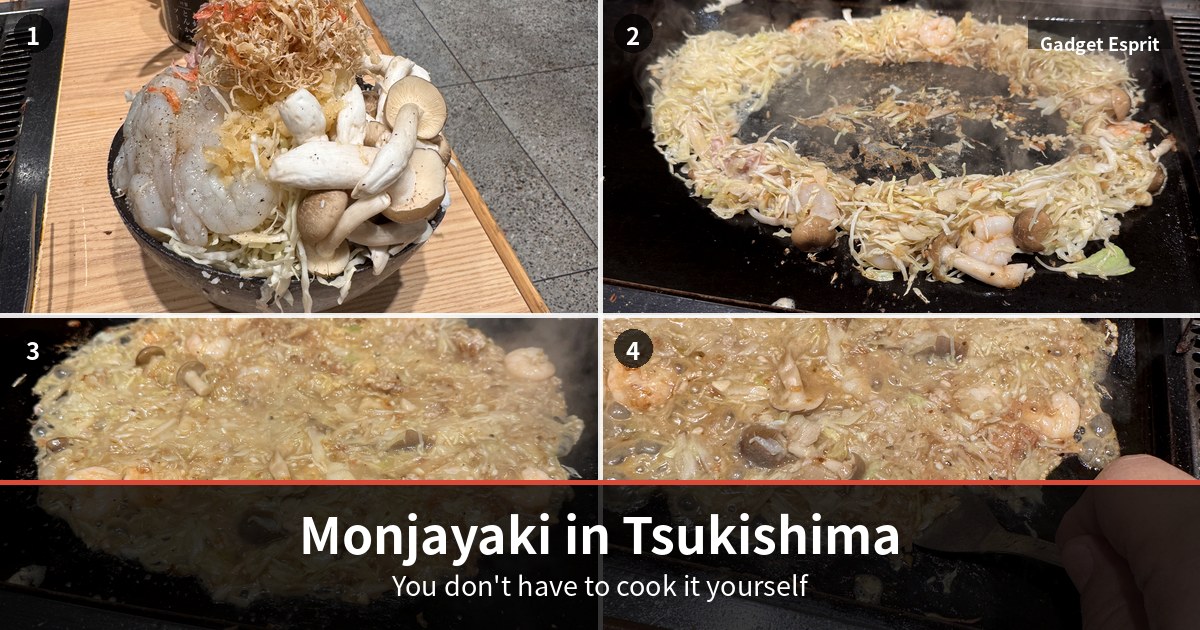
Monjayaki is Tokyo’s own thing. It’s a loose, savoury batter you cook on a hotplate at your table, and Tsukishima is the neighbourhood built around it.
Two things put visitors off it, and both are worth addressing before anything else: you’re supposed to cook it yourself, and the menus tend to be in Japanese.
We ate at Tsukishima Monja Koboreya Sohonten on Friday 7 August 2026, from about 17:20 to 19:35. We went as a family. At this branch, the staff offered to cook the okonomiyaki and monjayaki for us, and we let them; the teppanyaki we cooked ourselves. We ordered on our own phones — the ordering screen has a language switch that includes English, but we ordered in Japanese and didn’t use it. Here is how each of those worked on the evening we were there.
The short version
- The staff offered to cook it. For okonomiyaki and monjayaki, they asked which we’d prefer. We had all of ours cooked for us.
- The teppanyaki dishes we cooked ourselves. We did those, and they were the surprise of the evening.
- You order from your own phone, and the screen has a language switch including English. We ordered in Japanese and didn’t use it.
- Reserve. We booked through Hot Pepper Gourmet in advance.
- The one to order: the garlic shrimp monja, ¥1,490 before tax (¥1,639 with tax) as of August 2026.
- Ground floor (1F), on the monja street — the same company’s KAKOI is on the 6th floor of the same building, so check which door you’re going in.
Who actually cooks it
This is the question, so here’s the precise answer rather than the reassuring one.
For okonomiyaki and monjayaki, the staff asked us which we wanted — to cook it ourselves, or to have them do it. We asked them to cook everything, and they did, at our table, for every dish.
For the teppanyaki items, we cooked them ourselves. The staff offered to cook the okonomiyaki and monjayaki; we handled the teppanyaki ourselves.
On our visit, we could have avoided cooking entirely by ordering only from the okonomiyaki and monja sections. If you’re nervous about ruining a dish in front of a room full of people, ask the staff when you order — for us, it was offered without any fuss.
We ended up doing both, and I’d recommend that. We had the monja and okonomiyaki cooked for us, then ordered two teppanyaki dishes and cooked those ourselves. It turned out to be the right split: the fiddly thing done properly by the staff, and the simple thing done by us because doing it is half the fun.
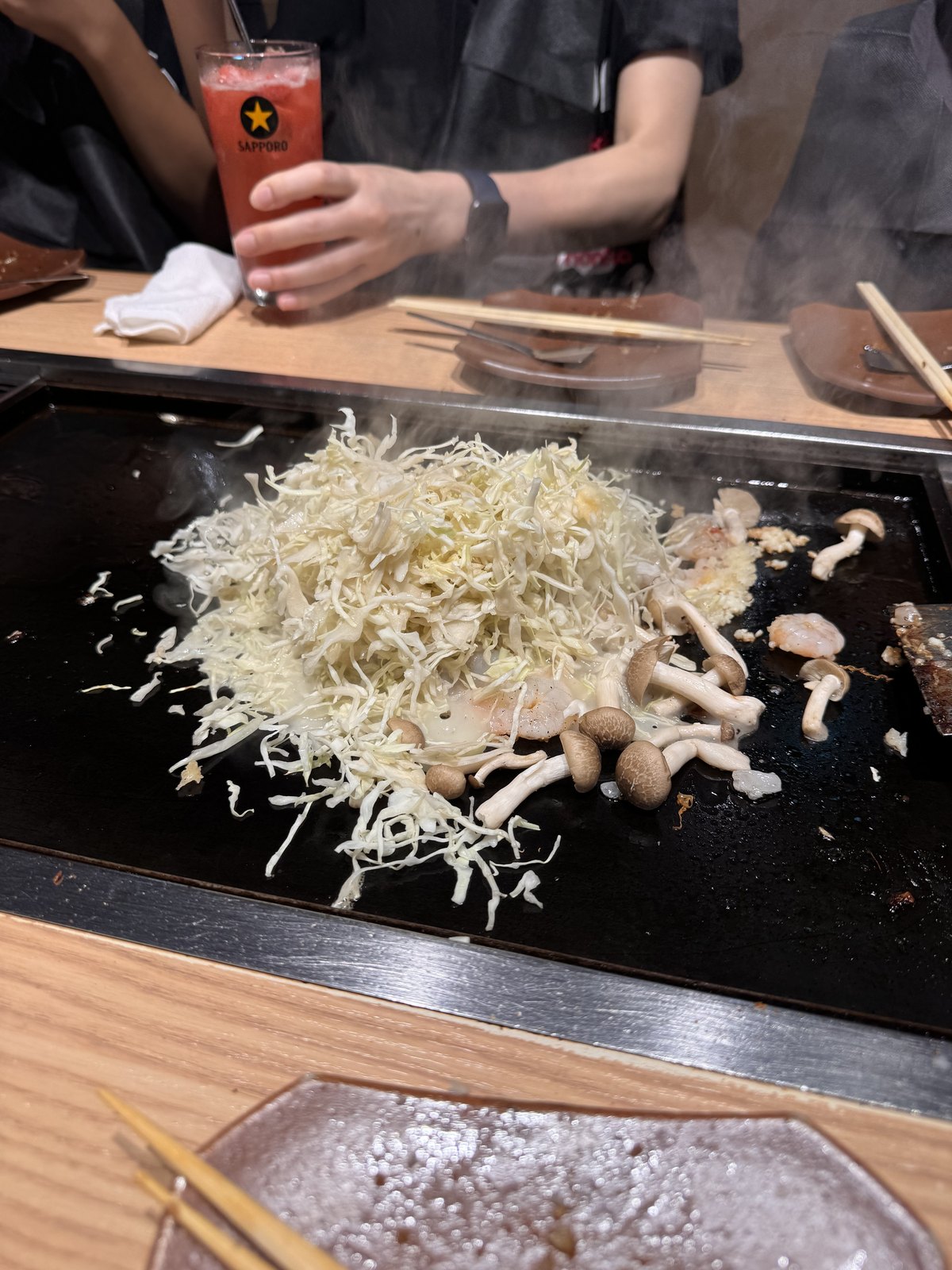
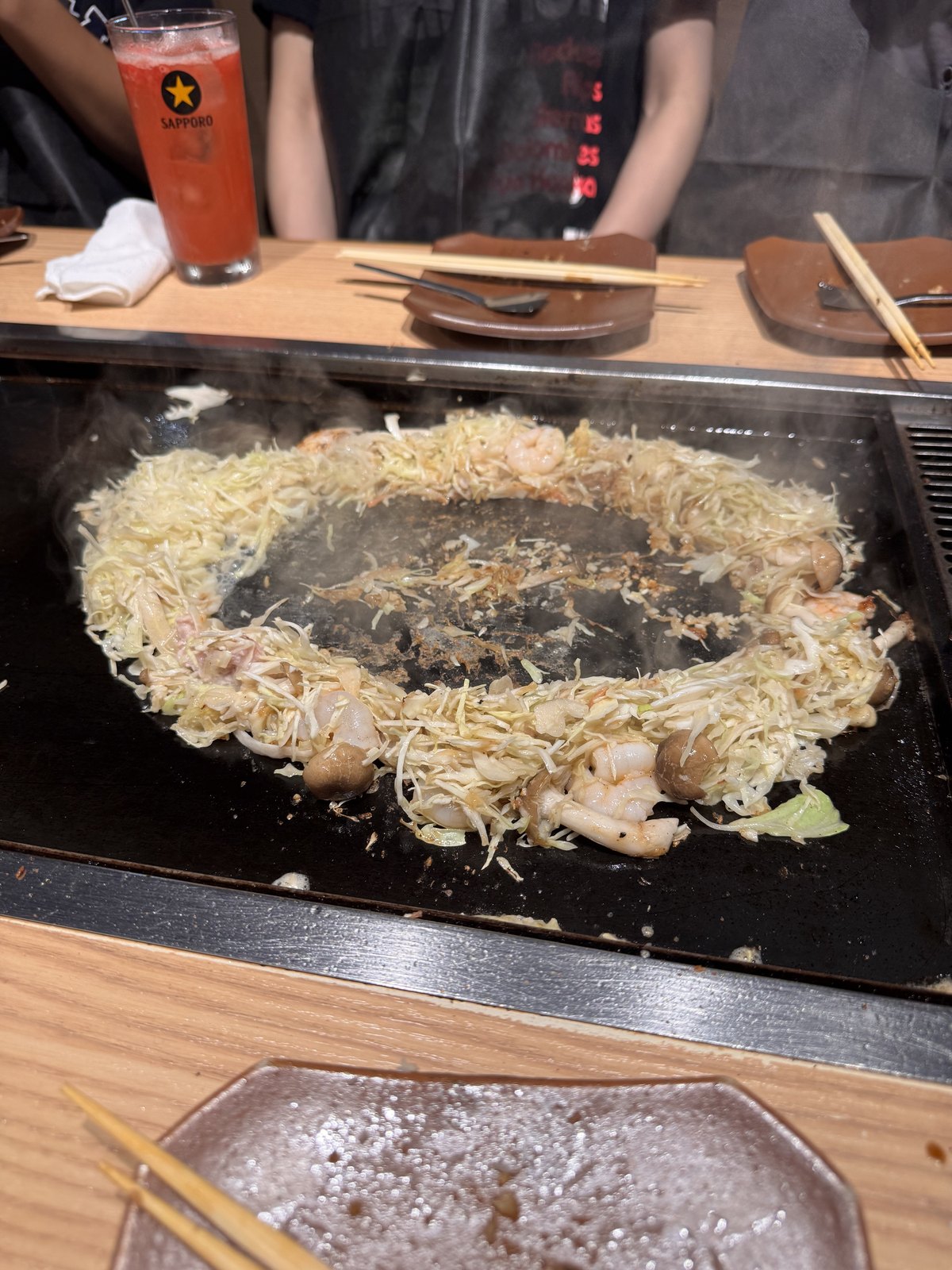
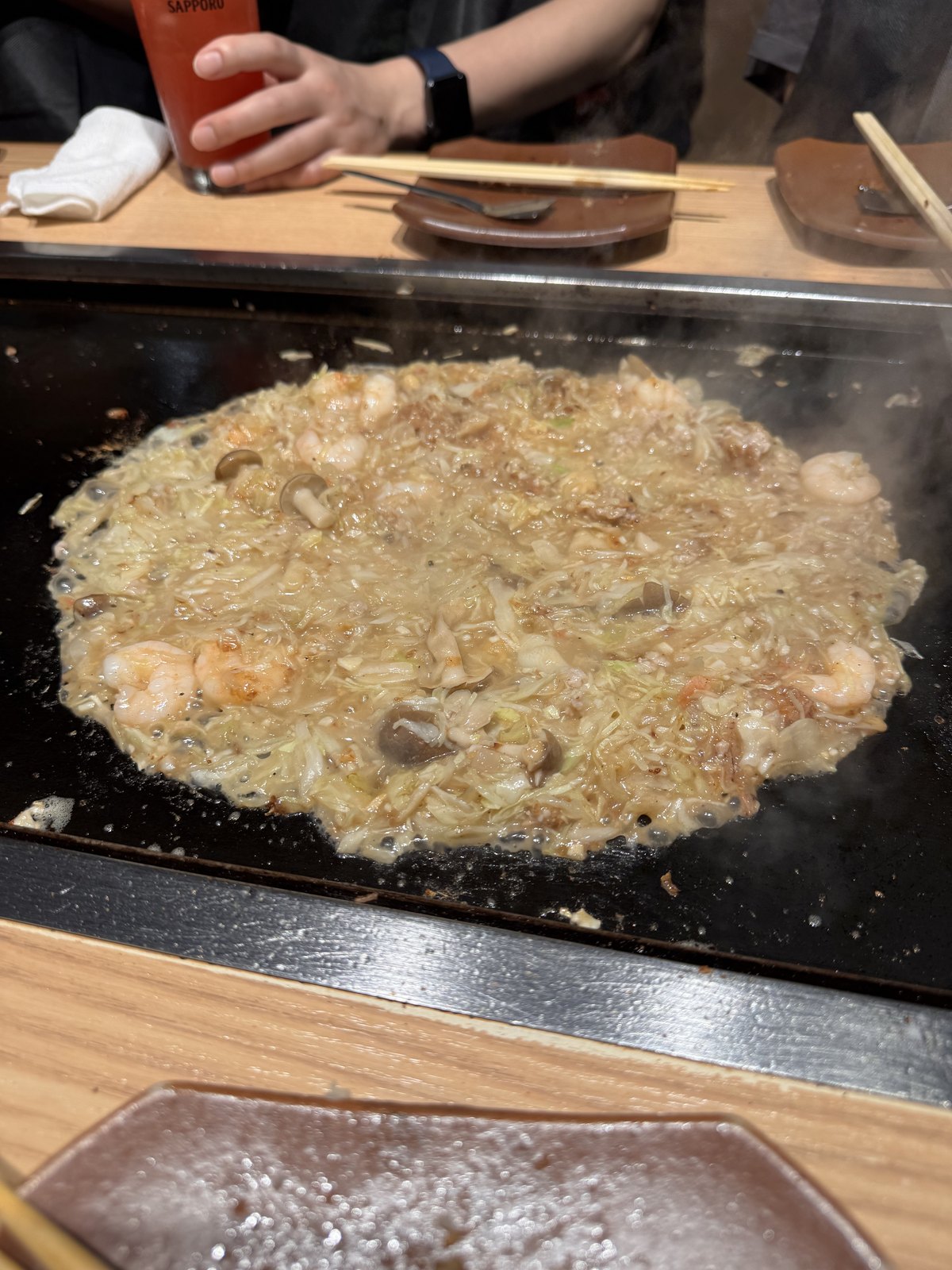
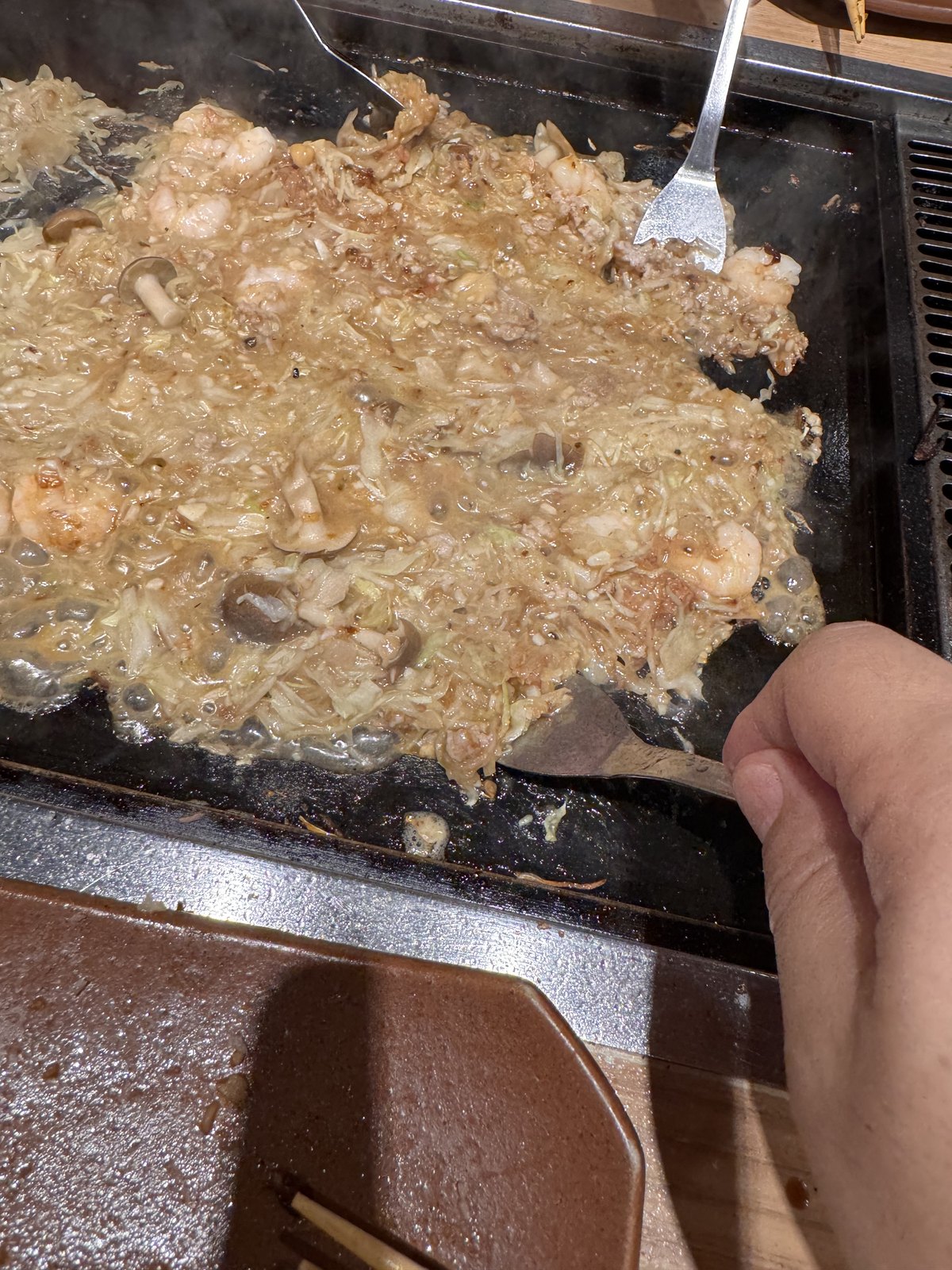
Watching it done properly is also, frankly, more interesting than doing it badly yourself. The ring of cabbage, the batter poured into the middle, the moment it’s all folded together — it’s a small performance, and it happens about thirty centimetres from your face.
Ordering, and the language
You order from your own phone. There’s a code at the table, and the ordering screen has a language switch that includes English.
One caveat, because I’d rather be accurate than encouraging: we ordered in Japanese and didn’t switch it over. I saw the option; I didn’t use it. So I can’t tell you how complete the English is, only that it’s there.
What I can say is that for us, ordering on our own phones took away one of the harder parts of eating out: we never had to catch anyone’s eye. Over a two-hour dinner we ordered in waves, whenever we felt like it, without flagging anyone down or attempting a conversation across a hot griddle.
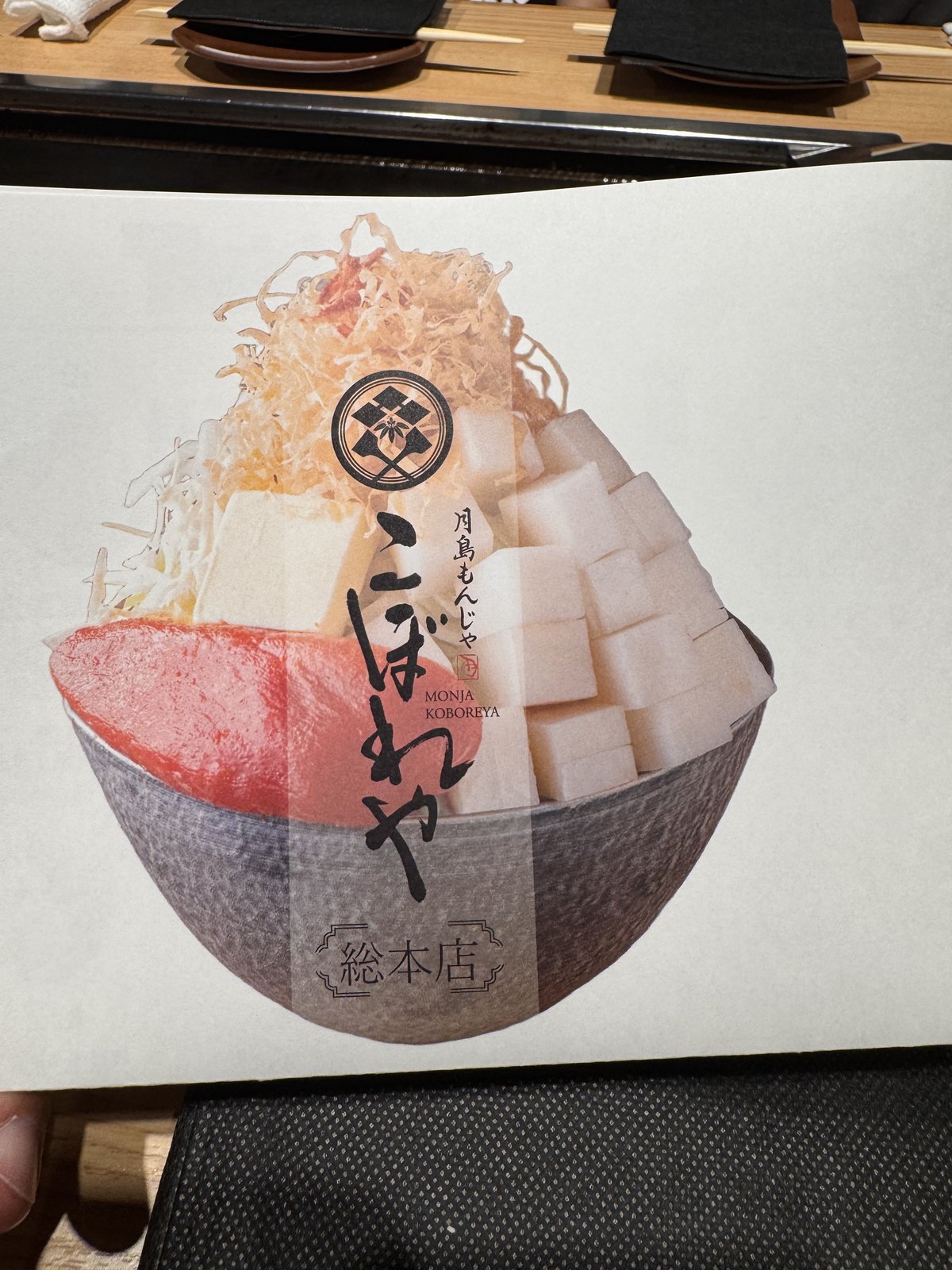
There’s also a paper menu with a photograph of every dish. That turned out to matter more than we expected — see the section on children below.
What to order
We had more than five dishes across the evening. The one worth naming:
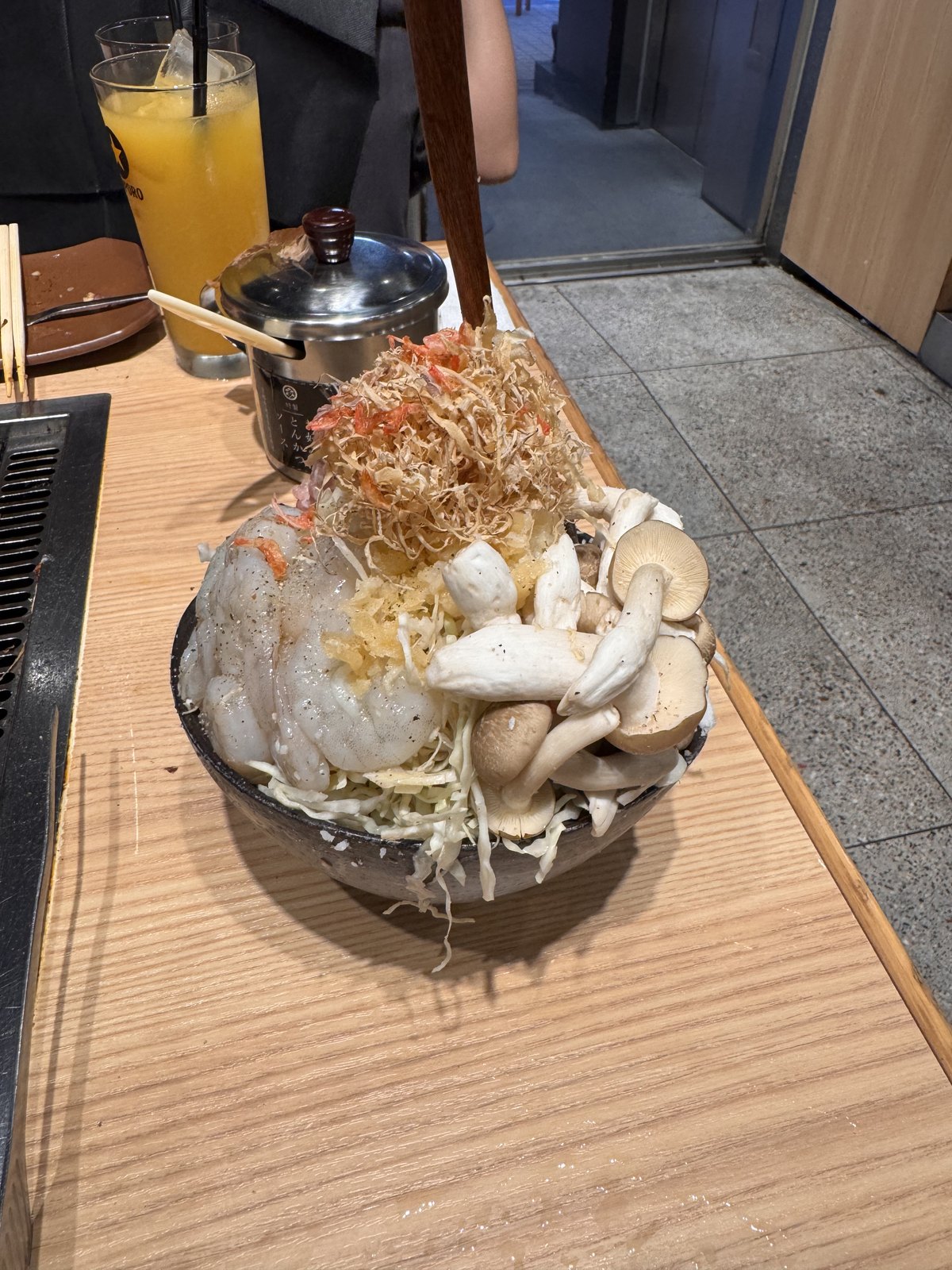
Garlic shrimp monja — “Toyosu-direct shrimp × plenty of garlic”, as the menu puts it. ¥1,490 before tax, ¥1,639 with tax, as of August 2026. The menu marks it as a shop favourite, and it deserves it: the garlic is not subtle, and that’s the point. It was the best thing we ate that evening.
There’s a small coincidence there worth enjoying: the shrimp comes from Toyosu market, and we’d spent that same afternoon in Toyosu. Dinner was sourced about fifteen minutes from where we’d been standing.
We also had an okonomiyaki with house-made beef tendon and Kujo spring onion, which was the first thing to arrive, at 17:52.
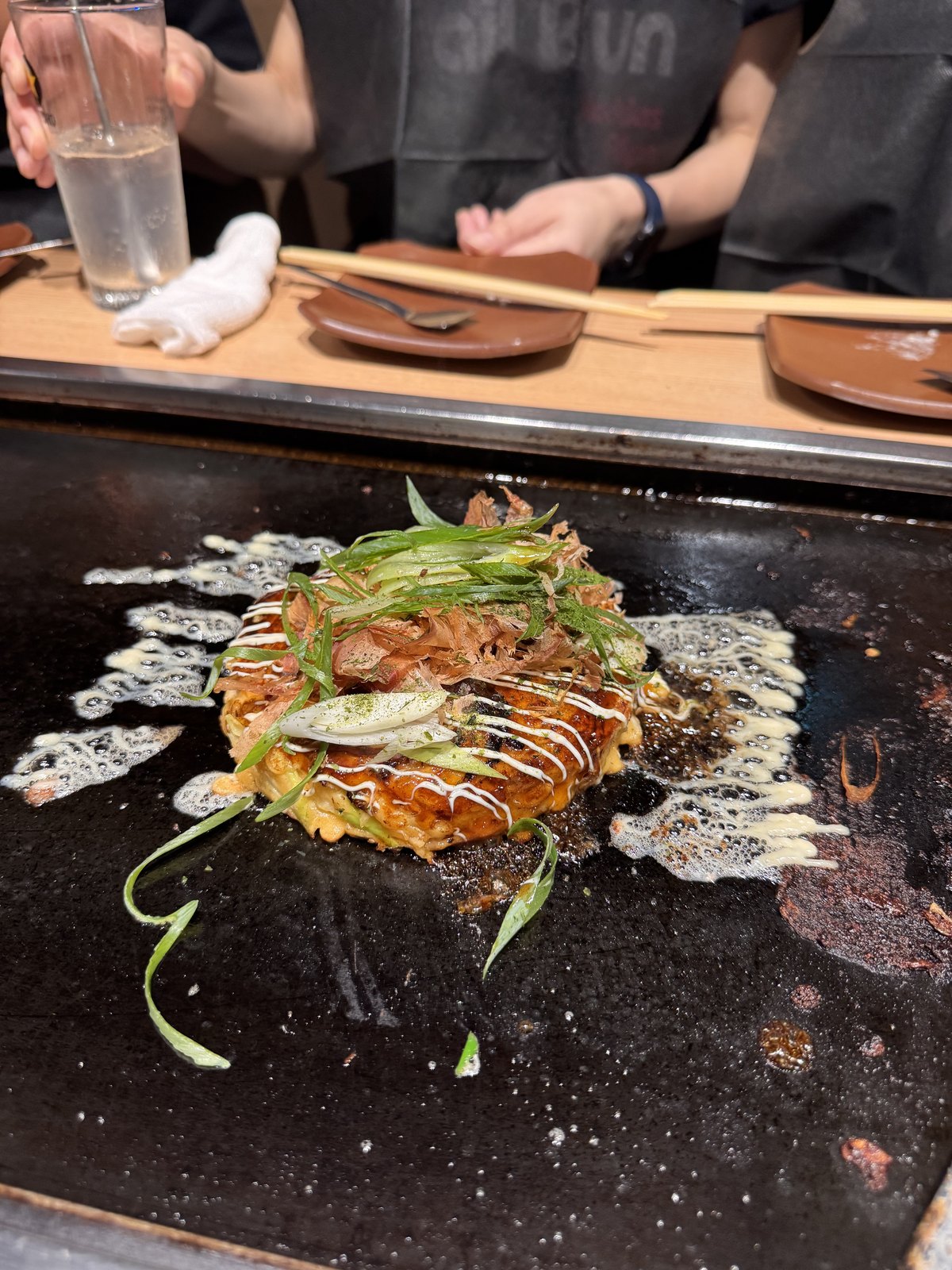
Later came a monja with octopus and house-made pesto, finished with Parmigiano Reggiano — not what anyone pictures when they think of monjayaki, and very good.
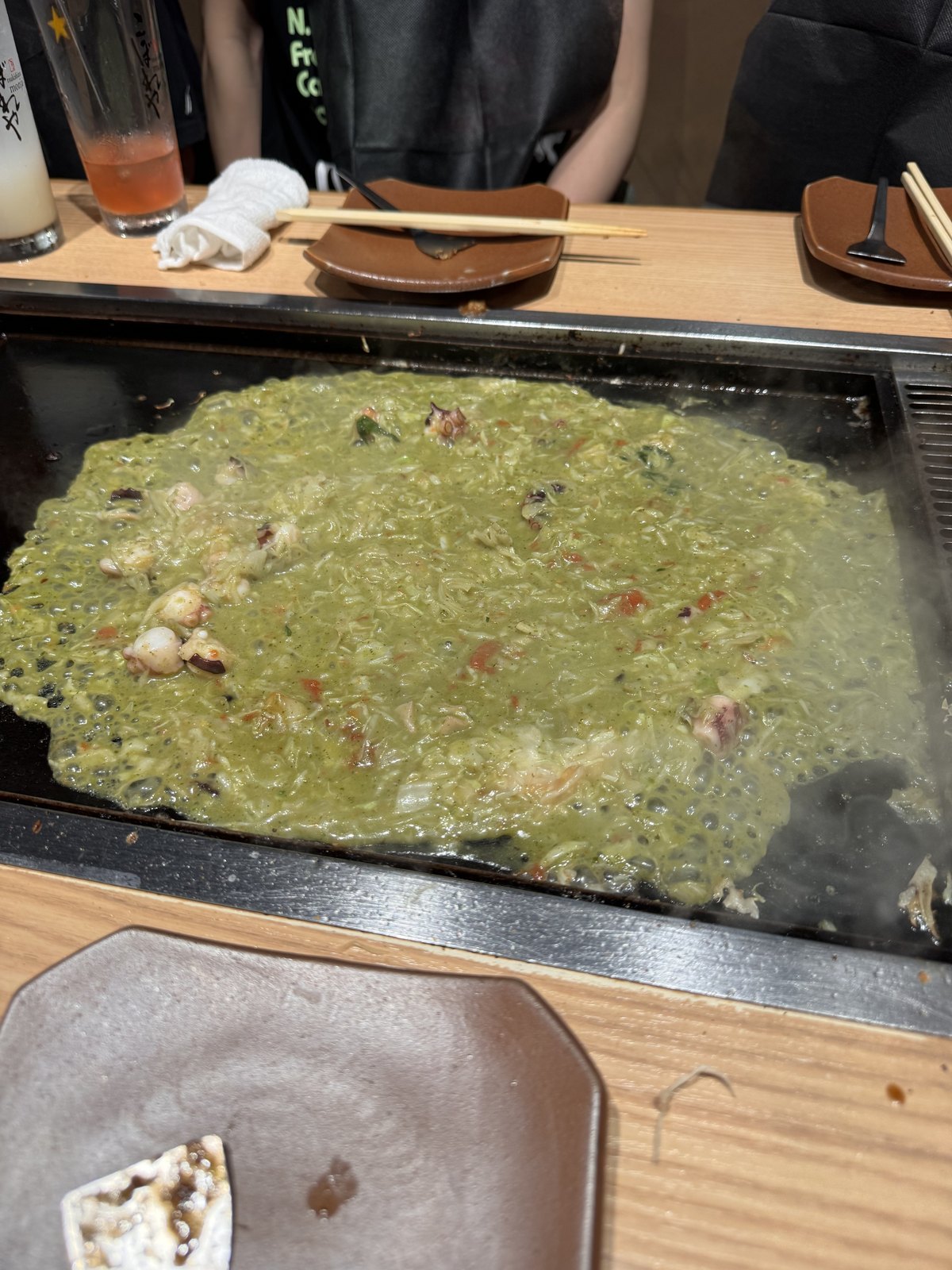
On prices generally: the monja dishes on the page we photographed ran from about ¥1,490 to ¥1,790 before tax. That’s a substantial dish each, and a group will want several. (As of August 2026 — check the current menu.)
The teppanyaki, which we cooked ourselves
This was the part we hadn’t planned on, and it’s the reason I’d tell you to order across both sections of the menu.
We ordered swordfish steak with garlic butter and whole grilled tsubo squid — both marked as coming direct from Toyosu market — and cooked them ourselves on the griddle.
They were excellent. Cooking them ourselves felt easy, and it was half the fun: the staff had handled the monja and okonomiyaki, where technique matters more, and what was left for us was simple to cook. That division worked well for us.
“Kobore” — why the bowls are heaped
The restaurant’s name, Koboreya, comes from こぼれる — to overflow.
That’s their style, and you can see it in the photographs: every dish arrives as a small mountain heaped up out of the bowl, and it’s still in the bowl when it reaches you. Nothing has been cooked yet. What arrives at your table is the raw ingredients, piled high, and then it gets turned into dinner in front of you.
If you’ve seen photographs of monja before and wondered why this restaurant’s look different, that’s why.
With children
Ours were fine, and better than fine.
They enjoyed watching it being cooked. With staff doing the work at the table, the whole process becomes something to watch rather than a job to manage — which, with children, is a meaningful difference. There’s fire, steam, and a lot of scraping, about an arm’s length away.
And they liked the food. That’s not guaranteed with monja, which has a texture that doesn’t look like anything else. It went down well.
One of ours ordered a dish off their own bat, having gone through the paper menu and found something they wanted — a pork and kimchi monja, made with Iwanaka pork and Japanese cabbage kimchi. That’s what the photographs on the paper menu are for, and it’s worth handing it to a child and letting them pick. It arrived at 19:17 and disappeared quickly.
The one thing to be aware of: the hotplate is the table, and it is hot. That’s true of every monja restaurant in Tsukishima and isn’t specific to this one, but it’s worth knowing before you sit small children down at one.
Booking
We reserved online in advance, through Hot Pepper Gourmet — one of the big Japanese restaurant booking sites — and we’d recommend booking somehow, whichever route you use.
The restaurant’s official English store guide lists each branch with its booking information and a map. We ate at SOHONTEN — choose that branch, not HONTEN (a different address) or KAKOI (the 6th floor of the same building).
We booked for 17:30, arrived a few minutes early, and they seated us straight away — we were eating by about 17:20. Two hours later, at 19:35, nobody had hurried us. That’s worth knowing if you’re used to places that turn tables briskly.
Tsukishima’s monja street is busy and the restaurants are small. Turning up and hoping is a strategy, but it isn’t the one we’d choose on a Friday evening.
One warning about finding the right door
From Tsukishima Station it’s Exit 5, then about five minutes on foot.
Here’s the part worth flagging: the monja street is exactly what the name says. It is lined with monja restaurants, one after another, and a lot of the signage is in Japanese only. If you can’t read it, they look very similar to each other.
Have the place open in Google Maps and walk with it. We’d suggest that even for a Japanese speaker, and more so if you aren’t one. Between the row of near-identical restaurants and the second branch upstairs in the same building, there are two separate ways to end up somewhere you didn’t mean to be.
The facts
As of August 2026. Prices and details change — check before you go.
Tsukishima Monja Koboreya Sohonten
- Booked online in advance through Hot Pepper Gourmet
- Garlic shrimp monja: ¥1,490 before tax / ¥1,639 with tax
- Monja dishes on the page we saw: roughly ¥1,490–¥1,790 before tax
- Ordering by phone at the table. A language switch including English exists — we didn’t use it, so we can’t vouch for the translation
- Okonomiyaki and monjayaki: on our visit, staff offered to cook them for us — they gave us the choice
- Teppanyaki items: we cooked those ourselves
- Paper menu with photographs of every dish
What we ate on 7 August 2026 (a Friday)
- 17:20 seated (17:30 reservation, seated early)
- 17:52 okonomiyaki — house-made beef tendon and Kujo spring onion
- 18:19–18:25 garlic shrimp monja — the best of the evening
- 18:59 octopus monja with house-made pesto and Parmigiano Reggiano
- 19:17 pork and kimchi monja — chosen by one of our children from the paper menu
- Teppanyaki, cooked by us: swordfish steak with garlic butter, and whole grilled tsubo squid — both from Toyosu market
- 19:35 left
Finding it
- Address: The City Tsukishima 1F, 3-7-12 Tsukishima, Chuo Ward, Tokyo
- From Tsukishima Station, Exit 5, then about five minutes on foot
- On the monja street, at ground level. You walk in from the street.
- The same company runs KAKOI on the sixth floor of the same building. SOHONTEN is the ground-floor one — make sure you’re going into the right door.
- We came from Toyosu on the Yurakucho subway line. Tsukishima is one stop.
Would we send someone here?
Yes — and specifically to anyone who has been putting monja off because of the cooking.
The two barriers people worry about are lower than they look. On our visit, we could hand the monja and okonomiyaki to the staff. And we ordered on our own phones — the screen has an English option, which we didn’t try — so we never had to flag anyone down or explain ourselves across a hot griddle.
What’s left is just dinner, and dinner was good.
If you’re in Tokyo and you want one meal that is properly of this city rather than of Japan generally, monja is a better answer than most, and Tsukishima is where to have it.
Order the garlic one.
Where this fits in the trip
This dinner was the evening of day one of a two-day family trip to Tokyo in August 2026. We’d come straight from teamLab Planets in Toyosu, one stop away.
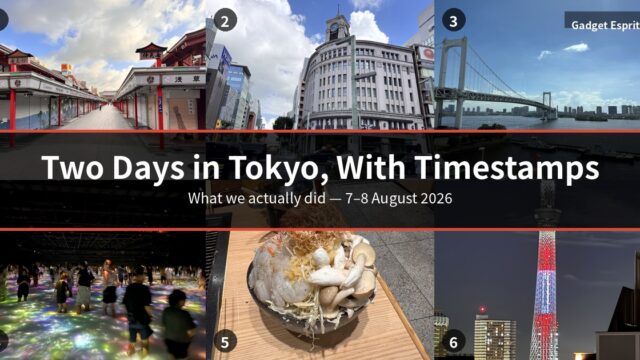
→ Two Days in Tokyo, With Timestamps: What We Actually Did — the full two-day record, every time taken from a photo.
→ teamLab Planets with Kids — the afternoon before this dinner.